


College Basketball Championship Teams Shared Traits Analysis:
This past week, I got a nice response from readers of my potential Super Bowl Champion Shared Traits article, which I released for the NFL playoff teams. I greatly appreciate the segment that Dave Ross and Jensen Lewis did on the subject in their Tuesday morning show VSiN By the Books. For those wondering, the three top qualifying teams for the 2026 Super Bowl crown are still alive, with the Rams and Patriots winning games this past weekend to join Seattle.
If that article was your first exposure to the methodology I use in a variety of sports each year, welcome. I hope you give the logic a shot; few are ever disappointed. That said, without a doubt, there is no sport I rely on it more for, or have been more successful with, than in college basketball. With that in mind, I am here to offer up my annual midseason college basketball shared traits of past champions piece so that bettors can take advantage in the futures market.
I have been pressed by several readers in recent weeks as to when this article would come out. I would like to offer that there are two specific reasons I waited until this particular week to do it. First, with the college bowl games and playoffs going on in the NFL, most VSiN readers are submerged in football, and this particular week sees a lightening of the schedule. Second, AND MORE IMPORTANTLY, I feel that with the regular season just over half completed now, and conference games well underway, the numbers for the teams gain more strength now. Any earlier, and it seemed like the numbers were weighted too heavily on non-conference schedule strength, which obviously varies drastically by team, thus introducing unrealistic stats and ratings. In my opinion, the CBB futures board hasn’t been picked over by the betting public yet because so many are still focused on the CFP football title and Super Bowl markets rather than March Madness. As such, bettors can still find some pretty strong value now in looking ahead to who could cut down the nets at Indianapolis in early April.
Before I begin showing you how I go about doing this shared traits exercise, this is one of the few times each year where I like to “toot my own horn” and tell you that I have done this right after New Year’s every year since Covid wiped out the tournament in 2020 and have been able to peg the eventual title winner in ALL FIVE YEARS! Admittedly, I give myself room for error by always picking a group of teams with the highest Shared Traits, and that number has ranged from six to seven teams over the last five years. That includes Florida at this time last year, when I recognized the Gators as one of six teams I felt were capable of cutting down the nets to close the tournament in April. That said, Florida was listed at 14-1 when I wrote the piece, so anyone who did invest one unit in all six teams I denoted at the time still was able to post a 9-unit profit. For reference, in 2024, the profit was 5 units, and in 2023 it was 14 units.
With that, I’d like to share the method I use to identify teams with championship-level DNA at this point in the season. Those of you who are well familiar will recognize it as the same process I always offer up come tournament time: Shared Traits Analysis.
The methodology centers around comparing current teams to past teams that have achieved a certain goal or level of success. I believe that while the teams and players might change from year to year, the overall resume of what it takes to be a champion does not.
For this exercise, I will take a snapshot of the key stats, rosters, and strength ratings of the country’s top teams and share which teams have the most traits befitting a title contender. Essentially, I pick out 12 different key statistical categories and four of my own personal Strength Indicators, plus a Combined Average Ranking. Here they are:
Steve Makinen’s Power Rating
Opponent Power Rating (Schedule Strength)
Offensive Points per Game
Defensive Points per Game
Steve Makinen’s Effective Strength Indicator
Steve Makinen’s Bettors’ Rating
Steve Makinen’s Momentum Ratings
Effective Offensive Points per Possession
Effective Defensive Points per Possession
Offensive Field Goal %
Offensive 3PT Field Goal %
Rebounding Percentage
Assist to Turnover Ratio
Offensive Turnovers per Possession
Defensive Turnovers per Possession
Defensive Field Goal %
Combined Average Ranking
After determining the national season rankings for all Division 1 teams, I compared them to the championship teams from the last 12 tournaments for further analysis. For each stat category, I look for minimum performance, typical national ranking, and the percentile of teams that qualify within certain ranges. As a final exclamation point on the analysis, I take a Combined National Ranking of the 16 sortable categories to separate the more complete teams from the rest.
In the past, when summarizing the findings, I have determined that the relationship between my Effective Strength Indicator was the most significant of all the categories analyzed. The average of the last 40 Final Four teams ranked about 15th nationally in that rating. Among the harder core statistical categories, Effective Defensive Points per Possession was most important. Interestingly, the least important factor was Defensive Turnovers per Possession, or the ability to force turnovers on defense. If you consider that last tidbit, you’ll better understand how a team like Houston, who has been a top seed often in recent tournaments, has been unable to reach the pinnacle, although the Cougars did play in last year’s national title game. The pressure defense is their strength, but it’s never proven to be a vital characteristic of a champion.
Shared Traits of NCAA College Basketball Tournament Champions
Recent years of tournament action have shown that there is a big difference in reaching the Final Four and winning the title. Typically, only the truly elite teams accomplish the latter. Last year, that point was again exacerbated, with Florida winning it all. Here’s a look at the minimum requirements for winning a tournament championship over the last decade-plus. Just to jog your memory, these are the 10 champions and their seed during that time span:
2015 DUKE (#1)
2016 VILLANOVA (#2)
2017 N CAROLINA (#1)
2018 VILLANOVA (#1)
2019 VIRGINIA (#1)
2021 BAYLOR (#1)
2022 KANSAS (#1)
2023 CONNECTICUT (#4)
2024 CONNETICUT (#1)
2025 FLORIDA (#1)
Looking for clear separations in the teams’ stats/ranks, of the last 10 NCAA Champions, I usually seek an 80th percentile or higher when separating the best from the rest:
- Nine of them went into the tournament with a Steve Makinen Power Rating of 89.5 or higher.
- Eight of them finished the regular season with a Schedule Strength ranked in the top 46 nationally.
- Nine of them ranked in the Top 55 in Offensive Points per Game and scored at least 76.5 PPG.
- Eight of them ranked in the Top 115 in Defensive Points per Game or allowed less than 70 PPG.
- Eight of them had a Steve Makinen Effective Strength Indicator Rating of at least +20 and ranked in the Top 5 nationally.
- Ten of them had a Steve Makinen Bettors Rating of at least -17.5 and ranked in the Top 5 nationally.
- Eight of them had a Steve Makinen Momentum Rating ranked in the Top 6 nationally
- Nine of them scored at least 1.245 Effective Points per Possession on offense and ranked in the Top 5 nationally.
- Eight of them allowed better than 0.965 Effective Points per Possession on defense and seven of them ranked in the Top 15 nationally.
- Nine of them shot at least 46.5% from the field on the season, ranking in the Top 45 nationally in FG%.
- Nine of them made at least 35.5% of their 3PT attempts on the season, placing them in the Top 100 of all teams.
- Eight of them had a Rebounding Percentage Rate of at least 53% and ranked in the Top 40 nationwide.
- Eight of them had an Assist-to-Turnover Ratio of at least 1.380, ranking in the Top 30 nationally.
- Eight of them ranked in the country’s 100 top teams in terms of Offensive Turnovers per Possession.
- Eight of them ranked in the country’s 190 top teams in terms of Defensive Turnovers per Possession.
- Nine of them allowed opponents 42.0% or less on field goal attempts, a mark typically good enough for the Top 75 in the country.
- Nine of them had a Combined Average Ranking of 50 or better in all of our analyzed stats.
Looking at each of these key categories and every team’s standing as of Monday (1/12), unlike last year, there is no team with a perfect 17 score. If you recall, Duke had that last year at this time and eventually lost in the Final Four. That was the first time since I started doing this midseason that a team had a perfect score. There is a team with a score of 16, one with 15, three with 14, one with 13, and one with 12, and another with 11 that I am adding in the group for reasons I’ll share below.
This season finds a heavy favorite to win the ’26 title according to the odds on DraftKings, Michigan at +390. Naturally, the Wolverines will be included in my potential title team grouping of eight teams, but they would be the only team to cost us profit should they win. Thus, you might find me rooting against them at tournament time. Two weeks ago, I found myself proclaiming that Michigan might be the “best team ever,” but after a loss and another close call in Big Ten play, head coach Dusty May’s team may be coming back down to earth.
If this is like any recent season, it’s a fairly safe bet to say that the eventual 2026 champion will be found amongst the top eight teams I list below, all with scores of 11 or more. Since I can take all eight and still guarantee even money if anyone other than Michigan wins, I will keep my group at this time to those eight teams at 1 unit apiece. You’ll see that I’ve mentioned others that I might still consider at a lesser investment. That said, if you aren’t thrilled with the prices on Michigan right now, I could see a situation of waiting until later, perhaps even at tournament time, to reconsider. I will have final season and tourney projections at that time. Again, this has worked in five straight seasons.

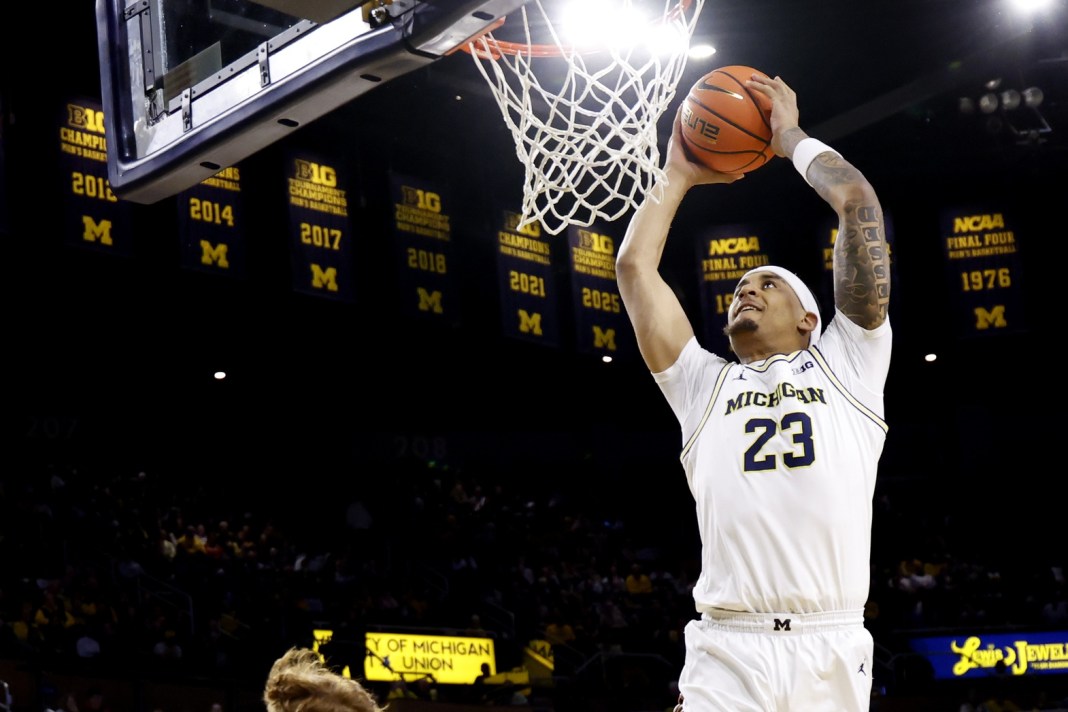
MICHIGAN (16 marks, +390): Michigan won its first 14 games before succumbing to Wisconsin at home this past Saturday. It took the Badgers getting 91 points to turn back the Wolverines. However, head coach Dusty May’s team survived a 2-point decision at Penn State earlier last week and had a pair of other games in November that were decided by 4 points or less. While the Wolverines have topped the 100-point mark seven times already this season, their biggest strength is actually their defense, where they lead the country in effective points per possession allowed. This team looks the part too, with incredible size and athleticism, particularly at the wing positions. With six players currently in double digits in scoring and only two underclassmen, this team is also deep and experienced. You have to wonder whether the Nittany Lions and Badgers may have cracked the code last week on what it takes to beat them, however. I really like what this team brings to the table, but I’d be willing to wait a bit or shop around for better than +390, as a crazy difficult conference road slate could have a way of bettering that number.
ARIZONA (15 marks, +700): Like Michigan, Arizona has put up an impressive early-season resume, although the makeup of the rosters is a bit different. Three of Arizona’s top 5 players are guards who are 6’6” or smaller, and the top two scorers are freshmen. Recall that Duke went with a similar recipe last season and came up short, largely due to inexperience at the end of the Final Four loss. Making the Final Four and winning a title are two entirely different things. The Wildcats have yet to lose in 16 tries and already boast impressive wins over the likes of Florida, UConn, and Alabama, among others. They are another team that faces a very tough conference slate, although I could easily see them reach 20-0 before a trip to BYU on 1/26. Currently ranking second in defensive efficiency, fifth in field goal percentage offense, and second in rebounding, this team brings a lot of balance to the table. Investing now at +700 will only bring us even money, if the Wildcats win it all. I think this price will be better down the line after a Big 12 loss or two.
GONZAGA (14 marks, +1500): The question is always the same about Gonzaga. Can the Bulldogs still be ready to make a tournament run after spending a couple of months frolicking through the West Coast Conference slate? This year’s team for head coach Mark Few has one distinct advantage over recent teams, however: veteran experience. Currently, of the top nine players in minutes played, eight are juniors or seniors. The two top scores are also bigs, 6’9” and 6’10”, so teams are going to have trouble matching up physically with this group at tourney time. Gonzaga’s one loss is a concern, a 40-point decision at the hands of Michigan, but this team has also posted double-digit wins over Alabama, Kentucky, and UCLA to counter it. The Zags’ biggest strength is putting the ball in the basket, as they currently are #1 in the country in field goal percentage. This stat has become more important in recent years of tourney play.
IOWA STATE (14 marks, +900) – It’s becoming a recurring theme among these top teams so far…upperclassmen leading the way. The same can be said at Iowa State, where five of the top 6 minutes played guys are either juniors or seniors. They have outstanding guards, are #2 in the country in 3-point shooting, and force turnovers on defense better than any other team in the country. What’s missing? Size. If there is any Achilles’ heel to what the Cyclones bring to the table this season, that would be it. Will they be able to match up with some of the teams I’ve already detailed when March rolls around? Or can head coach TJ Otzelberger use his team’s obvious strengths to cause the matchup problems for opponents? Any opponents of this team will have to be ready to get up and down and get out on shooters. This group already crushed Purdue on the road and edged St Johns and Iowa. Other than that, the schedule has been rather light. When you consider that Florida was +1400 at this point a year ago, is +900 a good price?
VANDERBILT (14 marks, +1900): If there’s any team on this list today that I am surprised to be writing about, it’s definitely Vanderbilt. The Commodores were only in the “others receiving votes” category for being nationally-ranked at the outset of the season, yet here they are, #10 in the country and yet to lose at 16-0. There could be some concerns about their having beaten only one ranked team to date, but according to my numbers, they are the #2 team in the country in current momentum ratings and are a top-15 team in both effective offensive and defensive efficiency. Keep in mind that all those ratings reflect schedule strength, so this team is doing what it’s supposed to do. The interesting thing that head coach Mark Byington will have to deal with the rest of the regular season and come tourney time is that his two top scorers are small guards, both 6’2” or less. They are the first such team I’ve detailed to have such a situation. Can that win nowadays? Why yes, it can…Florida had a similar roster makeup a year ago, with Walter Clayton and Alijah Martin as its top two scorers. The next three games (at Texas, vs. Florida, and at Arkansas) could tell a lot about this team’s chances of making a run later.
PURDUE (13 marks, +1100): I had the pleasure of seeing Purdue personally last week in Madison when they easily disposed of the Badgers. I’m not sure any team in the country has a more defined plan for where and how they are going to get their baskets, and they have perhaps the best facilitator in the country to orchestrate the proceedings. Guard Braden Smith is now a senior and as good as it gets in terms of leading a college team on the court. He is averaging 14/10 points/assists this year and still has much of the same supporting cast around him that he has had the last couple of seasons. Fletcher Loyer is a shooter/scorer, and Trey Kaufman-Renn is a post, and both thrive in working with Smith. The Boilermakers have just one slip-up this season, getting routed by Iowa State at home. Otherwise, they’ve yet to lose in road/neutral environments, with key victories over Alabama, Texas Tech, and Auburn. The ability to win those types of games is crucial to tournament success. Not surprisingly, head coach Matt Painter’s team is #1 in the country in offensive efficiency and #2 in assist/turnover ratio.
DUKE (12 marks, +1300): Duke has a similar roster makeup to last season, when it reached the Final Four before falling to Houston. Why would I include this year’s group on this list when last year’s highly touted group of Cooper Flagg/Kon Knueppel/etc. couldn’t reach the top? Well, this year’s Blue Devils top players might have flown under the radar a bit more, but that doesn’t mean they are any less, and that could be beneficial come tournament time. Last year’s team had a massive bullseye on its back. It’s hard to play through that for teams featuring a lot of underclassmen. Cameron Boozer is an absolute stud for this team, averaging 22.9 PPG and 9.5 RPG. Head coach Jon Scheyer’s team already has wins over six ranked teams in its 15-1 start, with just a single-point loss to Texas Tech as a blemish. According to my Bettors’ Ratings, Duke is the third-most respected team in the country by the betting markets. Eight of the last 10 champs were #4 or better in that rating.
ILLINOIS (11 marks, +2500): If you’re looking for perhaps a live underdog to consider for betting this season, Illinois could be your team. With all due respect to Connecticut’s hot start, as this last spot came down to the Huskies or the Illini, head coach Brad Underwood’s team seems to be finding its groove now and is a far better team statistically on offense. In fact, as of this writing, Illinois was around the top of the country’s ranks in several key categories, as they ranked fifth in effective strength, fourth in momentum rankings, third in offensive efficiency, and fifth in rebounding percentage. Those have all proven to be critical measurables in recent years of tournament action. Perhaps the most intriguing thing about this team for 2026 is the presence of numerous foreign-born players and offspring of former NBA stars. These guys are well taught, seem to be buying into what Underwood is selling now, and genuinely put the front of the jersey first. It should be fun watching this group the rest of the way.
Other potential considerations: BYU (11 marks, +2500), UConn (11 marks, +950)
Notable absentees from top contenders chart: Houston (8 marks, +1300), Michigan State (7 marks, +3000), Florida (7 marks, +3000), Tennessee (7 marks, +6000), Nebraska (5 marks, +4000)
Top mid-majors:
- Gonzaga – 14 marks
- Utah State – 8 marks
- High Point – 7 marks
- Saint Louis – 6 marks
- Akron – 6 marks
- Liberty – 6 marks