

One of the benefits of legal sports betting is that watchdog organizations can find and track nefarious behavior and the violators can subsequently be held accountable for their actions. Sports betting scandals are nothing new, but they are out in the open and far more public nowadays. While the sport(s) in question tend to get a bad rap, and, by extension, so does legal sports betting, the safeguards in place are doing what they are designed to do. In this case, it was point-shaving and wrongfully manipulating college basketball games.
In total, 29 basketball games involving 39 players were flagged for suspicious activity, both from a betting action standpoint and also a review of the film. Some even involved players who are currently playing this season. Nearly all of the incidents were from lower-division schools, so programs that don’t really have a lot of NIL money to throw around. In other words, players who are more vulnerable, even in the wild financial times we live in with present-day college sports.
Let’s talk about the What, the How, and the What Now from the unsealed indictment.
College Basketball Point-Shaving Scandal
The first thing to mention is that this isn’t a completely isolated series of incidents. Two of the defendants – Shane Hennen and Marves Fairley – were both charged on account of their involvement in the NBA sports betting scandal that centered around Terry Rozier, Chauncey Billups, and others.
According to the indictment, the first players were approaching prior to the 2023-24 season, along with a series of trainers, recruiters, and others who could help make connections or make players feel at ease.
NCAA President Charlie Baker said this in a statement: “Protecting competition integrity is of the utmost importance for the NCAA. We are thankful for law enforcement agencies working to detect and combat integrity issues and match manipulation in college sports.
The pattern of college basketball game integrity conduct revealed by law enforcement today is not entirely new information to the NCAA. Through helpful collaboration and with industry regulators, we have finished or have open investigations into almost all of the teams in today’s indictment.”
The intro to the statement also mentioned how the NCAA has “implored states to eliminate prop bets because of the integrity risks those bets pose”.
In this case, though, many of the wagers were on full-game spreads or first-half spreads. Pete Thamel of ESPN tweeted about some of the bets and also included screenshots from the unsealed indictment.
As you can see, some Chinese basketball was lumped into this whole scheme as well.
Point-Shaving Scheme Targeted Vulnerable Players
As mentioned above, these players were approached and utilized because they weren’t really in a position to benefit from the current landscape of college athletics at bigger programs. College and universities mentioned in the indictment were:
- Abilene Christian (Southland)
- Alabama State (SWAC)
- Buffalo (MAC)
- Coppin State (MEAC)
- DePaul (Big East)
- Eastern Michigan (MAC)
- Fordham (A-10)
- Kennesaw State (Conference USA; previously Atlantic Sun)
- La Salle (A-10)
- New Orleans (Southland)
- Nicholls State (Southland)
- North Carolina A&T (CAA)
- Northwestern State (Southland)
- Robert Morris (Horizon)
- Saint Louis (A-10)
- Southern Miss (Sun Belt; previously Conference USA)
- Tulane (American)
Not only do a lot of those institutions and players not receive much, if anything at all, in NIL money, but the games are going to be low-profile in a lot of those conferences and therefore less scrutinized.
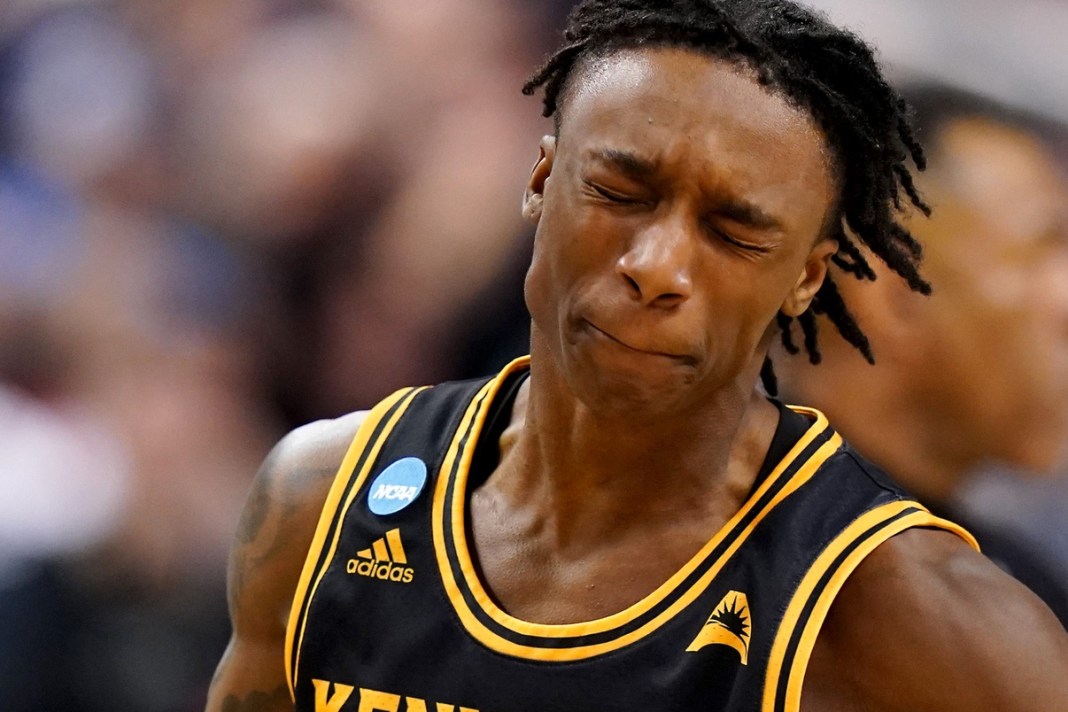
It should also be mentioned that Simeon Cottle, Kennesaw State’s leading scorer, has been suspended pending the result of this investigation. Three other active players, Carlos Hart (Eastern Michigan), Camian Shell (Delaware State), and Oumar Koureissi (Texas Southern), were also in the report.
What Now for College Basketball?
Well, the important thing here is that the checks and balances, the watchdogs, and the integrity firms did their job. While this investigation took a long time and had several layers across several leagues, the players have been outed and so have those who concocted the scheme.
That may not assuage the concerns of fans, bettors, and those who are against sports betting, but the hope would be that the thoroughness of the investigation and associated penalties will serve as deterrents for those who are considering something like this again down the line.
The future of prop betting at the NCAA level does continue to be a major question for sportsbooks, lawmakers, and could be under an even greater microscope with the rise of prediction markets.
Of course those who uncovered and prosecuted the individuals involved will always be on the lookout for these situations to protect the NCAA and the integrity of the games and wagering markets. So, don’t be surprised if we see another one of these at some point in time, but at least incidents such as these are now being handled properly instead of the alternative back in the day.