

As much as college football has changed, some things still remain the same. Group of Five programs continue to provide a feeder system for the deeper-pocketed Power Four schools in terms of coaching staffs. The G5 – now G6 with the return of the Pac-12 – presently doubles as a minor league system of sorts in the NIL era, where players are hoping to get called up to a major conference and a significant payday. There used to be a big imbalance, where mostly coaches would preach brotherhood, family, and loyalty and then bounce to collect a bigger bag. Players have that opportunity now, too.
There are 138 FBS schools this season, and 35 of them (25.4%) have new head coaches, if we include guys who are interims or had the interim tag removed. While not quite the 31.3% in the NFL with 10 new sideline bosses for 32 teams, it is another year of drastic turnover with coaches and players in college football. Hitting the playbooks is becoming more difficult than hitting the textbooks, as some of these players will go through multiple coordinators and head coaches while they’re in school.
With 30 and 28 head coaching changes over the last two seasons, respectively, we’ve seen some teams gel very quickly and others struggle to have everything come together. These are not professionals; they are student-athletes. While most of them are paid to play, maturity levels vary wildly at this age and some schemes require more focus and learning than others. It is important to know the teams with the new head coaches for a variety of reasons, so let’s look at them and try to pinpoint some teams that could improve right away, improve gradually, or could be in for a rough year.
Power Four Head Coaches
ACC
Tosh Lupoi (Cal): Lupoi’s first crack at being a head coach is with his alma mater and allows his coaching career to come full circle. Lupoi was a Golden Bear from 2000-05 and the program’s defensive line coach from 2008-11. In looking at Lupoi, it got me thinking about racehorses and bloodlines. Lupoi’s college coaching career has been under Jeff Tedford, Steve Sarkisian, Nick Saban, and Dan Lanning. He also spent three seasons in the NFL under Freddie Kitchens, Dan Quinn, and Urban Meyer. There is a ton of coaching experience in that list and the 44-year-old Lupoi had to pick up a lot of things. On the other hand, even well-bred horses don’t always work out and Lupoi, who follows another guy who had a lot of good mentors in Justin Wilcox, is another defensive-minded guy at a place that badly needs an injection of offense.
Tavita Pritchard (Stanford): In retrospect, I don’t think we give enough credit to Jim Harbaugh and David Shaw for what they did at Stanford. If somebody can replicate that in today’s NIL era, it will be one of the best coaching jobs we’ve ever seen. The program got a $50 million donation in October 2025 from former player Bradford Freeman and had instituted a revenue-sharing model in the spring of 2025. Even with the weight that a Stanford degree carries, Andrew Luck, and now Pritchard, who played for the Cardinal from 2006-09 and coached for them from 2011-22, know the academic requirements in Palo Alto severely limit the player pool. Pritchard has spent the last three seasons with the Commanders coaching up QBs, including, of course, Jayden Daniels. “Unimaginative” is the best way to describe the hire after Frank Reich responded to Luck’s plea to serve as a stopgap last season.
James Franklin (Virginia Tech): I made sure to double-check that Ohio State and Michigan did not move to the ACC before discussing Franklin. The guy is a solid motivator, a good recruiter, and a pretty lackluster in-game coach, but the conference lacks premier teams right now, and this is a perfect landing spot for him. As a guy who is just 8-7 in bowl games and 2-1 in the CFP, he’s had a very high regular-season floor with two 9-4 seasons at Vanderbilt in the early 2010s when that was a rough job, and six double-digit winning seasons at Penn State. There’s a lot of talent in the Hokies’ pipeline and Franklin, a southeastern PA native, should do very well recruiting in the DMV and the Keystone State. This could be (and should be) a quick transformation.
Big 12
Jimmy Rogers (Iowa State): Time will tell whether or not this is a good hire, but AD Jamie Pollard has made some good ones with Matt Campbell on the football side and Fred Hoiberg, Steve Prohm, and T.J. Otzelberger on the basketball side. He spent $4 million to buy Rogers out of his Washington State contract, so he was locked in from the jump on the 39-year-old, who won the FCS National Championship in his first season as a head coach at South Dakota State and lost in the semifinal in Year 2. This will be just his third year at the FBS level, having served as a GA at Florida Atlantic in 2012 under Carl Pelini and then as the head coach of Wazzu last season. Pollard unequivocally deserves the benefit of the doubt here and Rogers is inheriting a much better foundation than his predecessor did from Paul Rhoads.
Collin Klein (Kansas State): After spreading his wings to fly to College Station for two seasons, Klein is back in the Little Apple to coach at his alma mater. Klein was on the staff in 2014-15 and again from 2017-23, serving primarily as the QB coach and then OC. He’s one of the best players in the program’s history and he does seem to be a solid coach, given that he’s only 36 and already has this job after Chris Klieman and Bill Snyder, two guys who excelled in Manhattan for boosters and bettors. With OC Sean Gleeson and DC Jordan Peterson, this is a young staff that will learn and grow together, so bumps in the road are inevitable and this was just a 6-6 program last season.
Eric Morris (Oklahoma State): A return to the glory days of Oklahoma State football may not be that far away. It is hard to believe that this was a top-10 team in 2021 and a 10-win team in 2023 with just how badly it has gone the last two seasons. The Cowboys were a combined 4-20, prompting the pink slip for longtime head coach Mike “Teach Me How To” Gundy. That included an 0-18 record in the new-look Big 12. Enter Eric Morris, who played and coached under Mike Leach and Kliff Kingsbury, and who led North Texas to the program’s first AP ranking in over 65 years and a chance at being the G5 CFP representative. The gunslinger mentality is back in Stillwater and I think the Cowboys make a big leap, especially with an excellent DC in Skyler Cassity.
Morgan Scalley (Utah): After basically a decade of being the head coach-in-waiting, except for a short period of time after a scandal involving racial stereotypes, Scalley gets his shot with Whittingham off to Michigan. Scalley coached the Utes in the Las Vegas Bowl to a 44-22 win and now he’s the full-time guy. The Salt Lake City native played at Utah and has coached at Utah since 2007, serving as DC for the last 10 seasons. He certainly knows the program and is plenty familiar with the recruiting pipelines. It may work out, though Year 3 in the Big 12 might be a little bit rocky.
Big Ten
Kyle Whittingham (Michigan): Sherrone Moore’s ugly departure from Ann Arbor on the heels of Jim Harbaugh’s tainted National Championship created the need for a well-respected, accomplished football lifer to clean up the program. Enter Whittingham, who calls somewhere other than Salt Lake City home for the first time since he was the DC at Idaho State from 1992-93. I’ll be honest – Whittingham has long been viewed as one of the game’s elite coaches, both against the spread and in terms of maximizing talent. His Utah teams were always tough to face because of their presence in the trenches. But, I am skeptical of the 66-year-old entering the Big Ten and a program with extreme expectations.
Pat Fitzgerald (Michigan State): It might be unfair to call a College Football Hall of Famer an underwhelming hire, but this is an underwhelming hire. Fitzgerald was dismissed from Northwestern in 2023 following an investigation into hazing and sexual assault. A thorough investigation was completed and Fitzgerald was shown the door, though it’s hard not to wonder if he would have had more program support if the team hadn’t gone 1-11 the previous season and 3-9 the season before that. Either way, Fitzgerald, who was a volunteer coach at his son’s high school for the last three seasons, gets another chance after the aspirational hire of Jonathan Smith didn’t work out. It feels like the ceiling in East Lansing is very low moving forward.
Matt Campbell (Penn State): Of all the Power Four hires, this is the hardest one to project in my estimation. After a decade at Iowa State, where Campbell really built up the Cyclones amid a lot of financial and reputational shortcomings in a high-octane offensive conference, Penn State is a different beast. Campbell’s four-year run at Toledo was great and his decade in Ames was tremendous, but this is a BIG job. Campbell has strong Ohio ties, which should help with recruiting and he did really well to get D’Anton Lynn, a Texas native, as the DC, giving Penn State a lot of connections from coast to coast. What stood out at Iowa State is how Campbell maximized the talent he was able to recruit. With more fertile recruiting grounds now, what can he do with more talent? That’ll be the big question, and maybe one not quite answered in 2026.
Bob Chesney (UCLA): The hire of former James Madison head coach Curt Cignetti seemed to work out at Indiana, and now the Bruins’ athletic department is hoping for the same with Chesney, who was at Holy Cross prior to his two seasons with the Dukes. Chesney is a winner with a career 132-52 record and he took JMU to the College Football Playoff as the G5 representative last season. For a Bruins bunch that has only finished the season ranked one time since 2014, the bar isn’t terribly high, so Chesney, a strong hire by all accounts, has the chance to rapidly improve the program, even with a tough Big Ten schedule.
SEC
Ryan Silverfield (Arkansas): After a decade at Memphis, Silverfield packed up the family and took I-40 to I-49 for probably the only SEC opportunity he was ever going to get. It would be unfair to call him the last person at the bar when the “ugly lights” came on, but AD Hunter Yurachek had two strikes in the count and had to put a ball in play. Silverfield was seemingly the bronze medalist behind Jon Sumrall and Alex Golesh, and you can see why. He inherited a good program and a NIL budget filled by FedEx at Memphis and never won the conference. The irony is not lost on me that the Razorbacks went from an OL coach in Sam Pittman to another OL coach in Silverfield, as they look to finish the season ranked for just the second time since 2011.
Alex Golesh (Auburn): You can see what Auburn was thinking here, as the Tigers have scored just 18.5 and 19.1 PPG against SEC opponents over the last two seasons. Golesh is an offensive guy through and through, spending his entire collegiate coaching career on that side of the ball. After four seasons under Matt Campbell and three under Josh Heupel, Golesh got his first HC opportunity at South Florida and went 23-15 before taking the Auburn gig. Given that the defense is in the hands of veterans D.J. Durkin and Tim Banks, Golesh’s chief objective is to find points and he’s done that pretty much everywhere he’s been. His first-year success will be contingent on how the USF transfers adapt to P4 life, including QB Byrum Brown.
Jon Sumrall (Florida): Sumrall’s trajectory is becoming increasingly common in college football. The 43-year-old played four years at Kentucky, where he then served as a grad assistant from 2005-06 before getting a FCS gig at San Diego in his mid-20s. From there, he moved up the ranks, eventually serving as the co-DC at Kentucky before two seasons as the head coach at Troy and two at Tulane. Having immediate success adds commas to your bank account in CFB and that’s the case for Sumrall, who made the CFP with Tulane in 2024 and has won at least 11 games in three of his four seasons as a HC. While he inherited a mess at Troy from Chip Lindsey, he inherited a strong foundation at Tulane thanks to Willie Fritz. Florida, one of the sport’s premier programs, could be classified as somewhere in between, so we’ll see how long it takes Sumrall to bring them back to relevance.
Will Stein (Kentucky): Personally, I really like this hire, especially when paired with a strong DC grab in Jay Bateman. Stein, the mastermind of the Oregon offense the last three seasons, is a Louisville native and played QB there from 2008-12. Props to the Kentucky athletic department for realizing that the program needs to modernize offensively. What Mark Stoops did, including eight straight bowl game appearances from 2016-23, was very impressive with the team’s tenacious defense and ball-control offense, but for Kentucky to take the leap into being a legitimate contender, a more dynamic offense will be required, especially in the SEC. Former Dan Lanning OC Kenny Dillingham has done pretty well at Arizona State, but the Sun Devils were 3-9 in his first season as he tore the team down to the studs. Something to keep in mind with Stein.
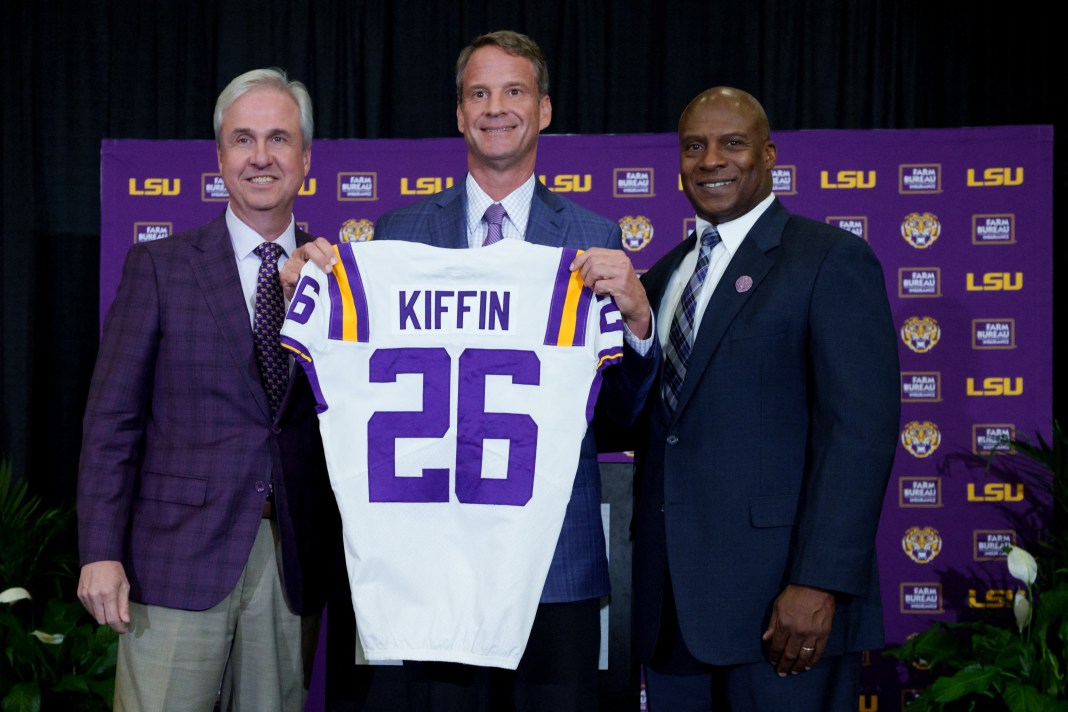
Lane Kiffin (LSU): The Lane Train made a lot of noise leaving Oxford for Baton Rouge, as he bailed on his College Football Playoff squad to set things in motion with the Tigers. There are a lot of must-see games during the CFB season – it’s possible that none of them will top September 19, when LSU visits Ole Miss. Lane is one of the most recognizable cast members in the college football soap opera, but he’s also a guy who recruited at an obscene level and led a collective 32-6 run over his final three seasons with the Rebels. Does his move to LSU conjure up memories of his ill-fated stint at USC? Probably, based on the blue blood running through the veins of both institutions. But we cannot argue that Kiffin plays an exciting style of football and gets dudes who can ball out on both sides. Just what LSU needs.
Pete Golding (Mississippi): This was a tough situation for AD Keith Carter. The players rallied around Golding amidst the made-for-TV drama of Lane Kiffin’s exit. At the same time, with Kiffin’s offensive reputation and penchant for recruiting, including the JUCO ranks, it is hard not to feel underwhelmed about Golding. That said, the Rebels played extremely well in the CFP, beating Tulane and Georgia before falling short to Miami. Golding has also worked under now-Browns head coach Todd Monken at Southern Miss, new Arkansas DC Ron Roberts at SE Louisiana, Frank Wilson at UTSA, Nick Saban at Alabama, and Kiffin.
Group of Six Head Coaches
American
Charles Huff (Memphis): This will be an interesting season for Huff. He seemed like a bit of an odd hire at Marshall, having primarily served as a running backs coach in his career, but he was on Nick Saban’s staff when the Thundering Herd came calling. After a 32-20 run in Huntington, he went to Southern Miss because Marshall let the reigning Sun Belt Conference champion head coach walk away. He took a big chunk of his roster to Southern Miss and went 7-5 before leveling up to Memphis. As mentioned above with Silverfield, Memphis has a pretty robust NIL budget thanks to FedEx and Huff, who has connections all over the country from his different stops, could find immediate and prolonged success with resources he didn’t have at his two previous stops.
Neal Brown (North Texas): I wouldn’t call myself a glass-half-full person by nature, but when it comes to new coaching hires, I’m often optimistic. I can’t say that about North Texas’s hire of Brown, who was let go from West Virginia in 2024 and served as Steve Sarkisian’s assistant in 2025. Brown has over 120 games of head coaching experience under his belt, all at the FBS level. He was very successful at Troy with three 10-win seasons in a row before heading to Morgantown. He is an offensive-minded guy, but not like Eric Morris, who ran more of a run-and-shoot style. It might work and the bar isn’t terribly high, given that the program has three winning seasons since 2013, but it feels like UNT is drifting closer to mediocrity again rather than living up to what should be their new standard.
Will Hall (Tulane): Losing Willie Fritz and then Jon Sumrall would be tough for any program, but not taking a third swing at a rising name feels like a miss. Instead, Tulane promoted pass game coordinator Will Hall, who had a miserable tenure at Southern Miss, going 14-30 over three seasons and seven games. Hall went to Hattiesburg after serving as Tulane’s OC in 2019-20 and was a fairly hot commodity after some strong seasons at West Alabama and West Georgia as a young head coach, but his star faded after the Southern Miss years. It just feels like the Green Wave took the easy route and that seems really disappointing.
Brian Hartline (USF): Suffice it to say that December 3 was a day that Ohio State fans had been dreading for a long time. Hartline, who was a star WR for the Buckeyes from 2005-08, was on the staff in Columbus from 2017-25 and directly responsible for Marvin Harrison Jr., Garrett Wilson, Emeka Egbuka, Jaxon Smith-Njigba, Chris Olave, Carnell Tate, and now Jeremiah Smith. The absurd receiver pipeline is just one attractive element to Hartline, who was Ohio State’s OC/co-OC the last three seasons. USF is looking to keep up the offensive prowess they had under another Ohio State alum in Alex Golesh, but it’s fair to question Hartline’s experience outside of his offensive bubble. Just as important as Hartline might be DC Josh Aldridge, who is just in his second year calling plays.
Conference USA
Casey Woods (Missouri State): Missouri State had to be quietly planning for Ryan Beard to be offered another job, but they probably didn’t think it would be so soon. With Beard off to Coastal Carolina following the program’s first FBS season, AD Patrick Ransdell, who got the job just before the start of the football season, moved quickly to hire Woods from SMU. Woods has worn a lot of different hats, including OC under Rhett Lashlee and director of player personnel at Auburn. Ransdell understands mid-major football, having worked at App State and UCF previously, so I think he’s trustworthy in isolating Woods as quickly as he did. A guy who has worked under Gus Malzahn, Bill Clark, Eli Drinkwitz, and Lashlee, and is also the son of 50-year coaching vet Sparky Woods, probably ends up being a solid hire.
Alex Mortensen (UAB): Mortensen isn’t a new head coach, per se, as he took over when Trent Dilfer was booted from Birmingham, but he’s the full-time guy now. He was 2-4 in his six games and led a big upset of Memphis in his first game at the helm, which may very well have been the deciding factor in just keeping him. The Dilfer hire was out of left field, to say the least, when the players desperately wanted Bryant Vincent to take over the job permanently when he filled in for Bill Clark, but that didn’t happen. Simply elevating Mortensen from OC reeks of being too cheap to make an impact hire.
Independent
Jason Candle (UConn): On the surface, this looks like a great hire. Candle went 81-44 at Toledo and had no problems succeeding Matt Campbell with the newfound success he brought to the Rockets. At the same time, Campbell only won the MAC twice in 10 seasons as the head coach and owns a career bowl record of 3-5. Not to mention, the Rockets have had a penchant for losing games as a big favorite, losing more than 10 times as a TD favorite from 2021-25. On the plus side, he won’t see a lot of big favorite roles with the Huskies. On the downside, a program like UConn simply has to win games in which they are favored and Candle has had major problems doing just that.
MAC
Mark Carney (Kent State): Anybody who wins five games at Kent State deserves Coach of the Year consideration. For Carney, starting the season 3-5 meant his interim tag was stripped off. The team was 0-16 in MAC play and 1-23 overall under Kenni Burnes, so Carney’s .500 record in the conference and 5-7 season was remarkable. While they fell short of bowl eligibility, they did beat rival Akron and also beat Bowling Green. The overall numbers look a lot worse given losses of 62-14, 66-10, and 44-0 to Texas Tech, Florida State, and Oklahoma in non-conference play. Otherwise, Carney’s team was competitive most weeks and should be again this season.
John Hauser (Ohio): “New” head coach is a loose term here, as Hauser was the assistant head coach and DC for the Bobcats before HC Brian Smith was placed on leave at the end of the regular season. There’s something to be said about continuity in college football in 2026 and Hauser follows Smith and Tim Albin, who were both on the staffs of their predecessors. Hauser has spent his entire FBS career in the MAC and is plenty familiar with the Buckeye State as a Columbus native and Wittenberg University grad, so he should be able to keep getting good in-house talent from a top-10, borderline top-five, state for high school football.
Alonzo Carter (Sacramento State): Two things first… Yes, Sacramento State is an FBS team now. And, yes, they are in the MAC. Carter is a Brent Brennan disciple in some respects, though he was already coaching high school ball when Brennan was playing for UCLA. Carter was on Brennan’s staffs at both San Jose State and Arizona, serving most recently as the assistant head coach and running backs coach. He hasn’t been a head coach since 2016 at Contra Costa Junior College. Given the wild commitment to the basketball team with head coach Mike Bibby and GM Shaquille O’Neal, Carter, a one-time backup dancer for MC Hammer, seems like an odd hire by comparison. However, the Oakland native is said to be a great mentor and resource for students.
Mike Jacobs (Toledo): Jacobs, a Maumee native from northwestern Ohio, worked his way up the hard way, serving as the head coach at Division II Notre Dame College (OH) and Lenoir-Rhyne before getting an opportunity in the FCS ranks at Mercer. It is kind of rare to see a head coach with this sort of path, as many have been coordinators or position coaches at the FBS level, and usually from a P4 school at some point. Jacobs is 94-23 in his career as a head coach and took Mercer to the FCS Playoffs in back-to-back seasons. Mercer had one of the nation’s best defenses in 2024 and the offense racked up nearly 500 yards per game in 2025. Given Candle’s inability to do what needs to be done as a favorite, this could end up being quite the upgrade.
Mountain West
Rob Harley (Northern Illinois): If Sacramento State being in the MAC wasn’t enough of a mind-eff, Northern Illinois is a member of the retooled Mountain West. Harley was the DC last season under Thomas Hammock and is the interim HC for this season after Hammock took a job with the Seahawks. Harley is a Pat Narduzzi disciple and also was a GA under Narduzzi and Mark Dantonio for two years. The 43-year-old has never been a head coach, and finds himself in a weird situation to say the least with the travel, games at elevation, and the transfer portal opening up when Hammock left in February.
Pac-12
Jim Mora (Colorado State): Let’s all take a second and come to terms with the fact that Colorado State is now in the Pac-12…Alright, now let’s think about Mora, who got a second kick at the college coaching can at UConn and did extremely well with it. The football lifer was 27-23 in Storrs with back-to-back nine-win seasons, which is no small feat. His first four seasons at UCLA were pretty good, but the bottom fell out quickly. To provide some continuity, Mora kept interim HC Tyson Summers in his previous DC role. The Rams haven’t won a bowl game since 2013 and have had a winning record just once since 2017. Perhaps Mora’s previous stops are examples of what he can do at schools with lowered expectations, much like this one.
JaMarcus Shephard (Oregon State): Going the defensive route didn’t work, so Oregon State has gone in the other direction. Tyler Bray really walked into a brutal situation after Jonathan Smith left, as the Beavers floated around like a feather in the wind when the Pac-12 dissolved. They played as a Pac-12 team in name only, mostly facing a Mountain West schedule and even played fellow orphan Washington State twice last season. Bray went 5-14 and now Shephard, a longtime wide receivers coach, most recently with Kalen DeBoer at both Washington and Alabama, takes the reins. Like Washington State, Oregon State should be ready to invest in the program with a conference to call home again, but Shephard has never been more than a co-OC/assistant head coach and now is a head coach looking to install a dramatically different offense.
Kirby Moore (Washington State): Moore, whose time at Boise State crossed over with brother Kellen, who has a slightly more high-profile job, is on the fast track. The 35-year-old isn’t coaching the Saints like his 37-year-old brother, but three years of calling plays at Missouri and one at Fresno State now has him in a head coaching role. Grabbing a branch of the Chris Petersen, Kalen DeBoer, Eli Drinkwitz coaching tree is far from a bad idea, but he’s going to need to grow into the role with a program that hasn’t really been investing in its roster while being a Pac-12 orphan with Mountain West guardianship. Now back in the Pac-12, the program will invest in the head coach and the roster all at once and that will probably take some time.
Sun Belt
Ryan Beard (Coastal Carolina): After overseeing Missouri State’s transition from FCS to FBS, Beard took the Bears to a bowl game in their first season as a member of Conference USA. He didn’t coach in it, as Coastal Carolina came calling and he hit the ground running in Conway. Beard, who is Bobby Petrino’s son-in-law, was at Missouri State for six seasons, first as the DC under Petrino and then as the head coach when Petrino went to be the OC at Texas A&M. Beard, who was a defensive back at Western Kentucky, has been very successful in getting his players to get to the quarterback. Coastal Carolina only had 19 sacks last season and their 80 sack yards were the seventh-fewest. Just some food for thought.
Billy Napier (James Madison): Following up Curt Cignetti and Bob Chesney was going to be an unenviable task for anybody, but it’s “Sun Belt Billy” who gets the chance. Look, his stint in Gainesville was an abject disaster, but he was really good at Louisiana, winning 40 games in four seasons. He inherited a solid foundation from Mark Hudspeth and gets the same here with the Dukes. Florida is a different beast and some guys just aren’t built for that burden. If JMU struggles, it’ll likely be less about Napier and more about the mass exodus of talent over the last two seasons.
Blake Anderson (Southern Miss): Anderson’s second stint at Southern Miss was to serve as the OC and QB coach, but Charles Huff left for Memphis and the Golden Eagles opted to keep it in-house with Anderson. He’s got a decade of FBS coaching experience, but also had an unceremonious departure from Utah State and didn’t coach in 2024. He took Arkansas State to new heights from 2014-20 and had an 11-win season at Utah State to start his tenure, but this is a fairly uninspiring hire in Hattiesburg. He’s won at both stops and has done so while navigating some very difficult and tragic family circumstances, so we’ll see how this stop goes.