


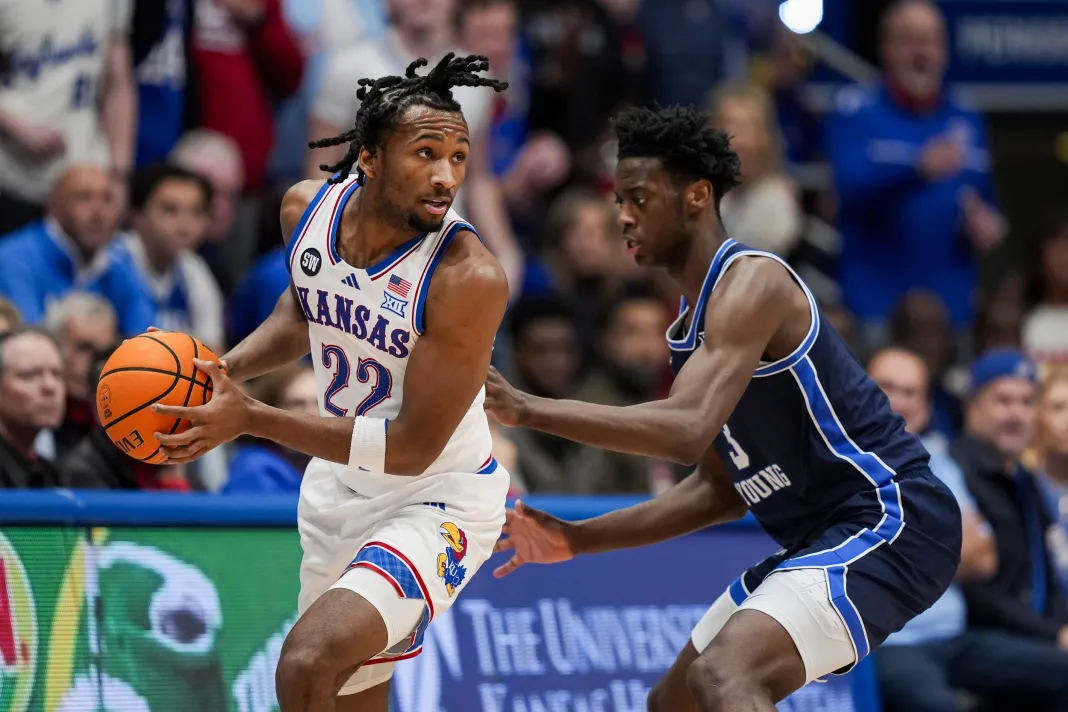
While Dylan Harper was widely considered to be an awesome prospect last year, Cooper Flagg was the heavy betting favorite to go No. 1 in the 2025 NBA Draft. That’s precisely where the talented wing ended up going, as he was selected by the Dallas Mavericks. Well, there’s a little more mystery when looking at the top of the 2026 NBA Draft. As of right now, it looks to be a three-man race between Kansas’ Darryn Peterson, BYU’s AJ Dybantsa, and Duke’s Cameron Boozer. And realistically, when looking at the betting odds, it might be down to just Peterson and Boozer.
At FanDuel Sportsbook, Peterson is listed at -135 to be the first pick in the draft, while Dybantsa is +135 and Boozer is +750. I personally believe Boozer deserves a little more consideration at No. 1, as it’s rare that a 19-year-old freshman leads all of college basketball Box Plus-Minus. Boozer is doing exactly that with the Blue Devils this season, as he has a BPM of 18.8. The second-best player in the nation in that regard is Michigan’s Yaxel Lendeborg, whose number is way down at 14.7 — despite being four years older than Boozer. It just shouldn’t surprise anyone if Boozer, who is averaging 22.7 points, 10.1 rebounds, and 4.0 assists per game and is currently a heavy favorite to win the John R. Wooden Award, ends up being the best player in this class. He has a special blend of size, strength, skill, and feel. Those guys rarely fail at the next level. However, I do understand that he’s a different type of athlete than the other two, as he’s not that quick and he doesn’t play above the rim. Because of that, teams could believe he doesn’t have as much upside.
With Boozer seemingly out of the running, the decision at No. 1 will come down to Peterson vs. Dybantsa. And watching it all unfold will be extremely interesting.
Heading into the 2025-26 season, I felt Peterson was the best prospect in this class. In high school, Peterson was an explosive athlete that consistently put pressure on the rim, had a good handle on serving as a lead guard, and played with some serious intensity on both ends of the floor. However, with Kansas, Peterson has mostly served as an off-ball player, and really looks more like a movement shooter. And “movement” feels somewhat misleading there, as I’m not sure I’ve seen Peterson sprint since getting to college. He’s slowly jogging around the floor, looking like the people in high school that are embarrassed to sweat during gym class.
Peterson has simply had one of the most bizarre college seasons in recent memory, as he’s pulling himself out of games with physical issues that haven’t been made widely available. He has also missed a decent chunk of games. That has led to some visible frustration from Jayhawks head coach Bill Self, and Peterson has also been the target of a lot of criticism — from fans and the media.
Peterson just hasn’t been the same player or person we saw in high school, and there’s a ton of speculation as to why. Is he dealing with some sort of long-term injury that could be made worse? Does his camp have a personal minutes restriction on him? Is there an NIL deal that’s calling for him to appear in a certain number of games, and half-assing to avoid injuries will ultimately earn him a fat check? Maybe he wants to go to a certain NBA franchise, and he can steer his way to that destination by being a walking red flag to the others?
No matter what it is, it’s messy. You know who isn’t messy? Dybantsa. The Cougars freshman is 6-foot-9 and built like a brick sh*thouse. He’s currently averaging 25.1 points, 6.8 rebounds, and 3.8 rebounds per game, taking on an outrageous 32.6% usage rate for a BYU team that has a chance to make a run in the NCAA Tournament. Dybantsa isn’t just big but he’s one of the draft’s best athletes, he’s highly skilled, and he’s driven to be one of the best players in the world.
Dybantsa’s ability to score in the mid-post, move like a guard when attacking the basket, and just be an overall presence on both ends of the floor gives him an insanely high floor. It almost feels like his worst-case outcome at the next level is looking something like Julius Randle. Meanwhile, the high-end outcome is performing like an All-NBA talent that fits in most lineups and terrorizes opponents.
Dybantsa just has a bit of a mixture of Peterson’ upside and Boozer’s instant production, and that’s going to make him very difficult to pass on at No. 1. There’s undoubtedly a world in which Peterson gets to the pros, no longer feels like he’s at risk of injuring himself and ruining his future, and gets fully unleashed as a more athletic — but smaller — version Cade Cunningham, or a better shooting version of John Wall. Given what he did in high school, that can’t be ruled out — and I personally believe he’ll be a star. However, people are putting their jobs on the line when making these decisions, and passing on Dybantsa could ultimately do a front office executive in. He’s considered a “sure thing” and there’s some risk there when sticking your neck out for Peterson, who is going to need to convince NBA teams that he loves the game — and have a damn good explanation for what we’ve seen with the Jayhawks this year.
It has also been reported that the Jazz and Kings would take Dybantsa with the No. 1 pick, and those are two teams that have a real shot at ending up at the top of the draft. Also, a team like the Pacers, with Tyrese Haliburton, Andrew Nembhard, and Aaron Nesmith already part of the long-term core, would likely prioritize a wing over a guard at No. 1.
There’s just a very strong case for Dybantsa to be the first player picked in this loaded 2026 class, and the fact he’s out there at plus-money odds is somewhat shocking. The only way I’d feel terrible about holding this ticket is if the Hawks end up winning the lottery, as they’re as guard-needy as any team in basketball. That said, I’d suggest firing up a multi-unit play on Dybantsa to go No. 1. It’s a three-unit pick for me.