



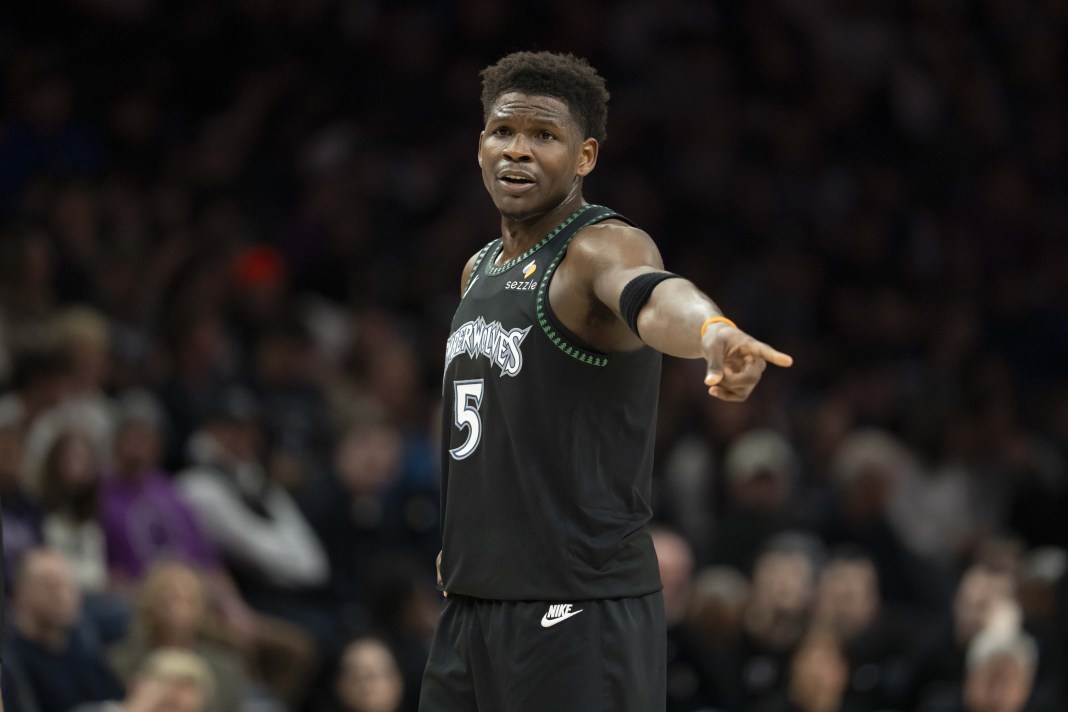
It’s not often a team can rebuild the plane while it is in the air, but that is seemingly what Minnesota did this offseason. The Timberwolves of the last few seasons were a big, plodding team that relied on its size and defense to consistently compete in the Western Conference. However, it seems general manager Matt Lloyd and president of basketball operations Tim Connelly saw enough.
The Timberwolves have completely shifted their DNA to a more sleek, skilled roster archetype. Julius Randle and Naz Reid are gone. LaMelo Ball was the massive trade acquisition, and the retaining of Ayo Dosunmu now gives this team a whole new identity. Gone is the team built to beat Denver. In its place is a team that is smaller and more versatile and should be able to compete in a very skilled conference.
BURNING QUESTIONS
What can Ball do for the Minnesota Timberwolves?
First and foremost, he can dribble a basketball, and that is not just a joke. The Timberwolves’ offense lacked a true second option as a ball-handler and facilitator outside of Anthony Edwards. Simple double-teams would throw wrenches into Minnesota’s offense. Edwards is a great scorer, but navigating doubles and running the offense should not fall on his shoulders. Enter LaMelo. Ball’s presence immediately relieves that pressure. A double of Edwards now gives the ball to Ball with him and three others owning the brief personnel advantage in those situations. He is also a great pairing with Rudy Gobert, who can serve as a lob threat on pick-and-rolls with Ball in control. There are obviously concerns. Specifically, Ball’s availability has been an issue. He’s played more than 47 games in a season just once since his second year in the league. Ball can also be a chucker, as evidenced by his 40.7% shooting from the floor last season. Still, he is a very good fit for the Timberwolves, and it all works on paper.
Is a monster season loading for Edwards?
Edwards has clearly established himself as one of the best scorers in the NBA. The 2025-26 season brought a career high in points per game (28.8), field goal percentage (48.9%), and three-point percentage (39.9%), as well as a handful of other advanced metrics. Where Edwards has picked up his game is at the rim, where he hit a career-best 71.3% of his attempts. He did this without a true secondary option next to him on offense. Now, he has two. Ball is obviously a scoring threat that teams will have to respect, and Finch can get versatile now with his lineups and toss out Dosunmu to play with Ball and Edwards, giving opposing defenses some real issues with three ball-handling scoring threats on the floor at once. All of this should lead to a floor that has likely never been as open as it will be for Edwards this season. If the former top overall pick can maintain his efficiency, this season has the makings of one in which he can truly contend for MVP, for which he is 18-1 to win at DraftKings.
How do the personnel changes alter the Timberwolves’ defensive identity?
Minnesota was built on its defense the last few seasons, but with the departures of both Randle and Reid, this team is now much smaller. The potential starting five for the Timberwolves is likely Ball, Edwards, and Gobert with Jaden McDaniels and perhaps Jonathan Kuminga on the wing. McDaniels is an extremely gifted on-ball defender, but he is small for a power forward. Last season, when McDaniels played the four, the Timberwolves were outscored by 8.7 points per 100 possessions. He only played 5% of his minutes there, but it is a good illustration of what might ail Minnesota this season. Gobert is still one of the most effective defenders in the league. When he was on the floor last season, the Timberwolves allowed 11.8 fewer points per 100 possessions, and opponents’ effective field goal percentage dropped by 4.1%. But the team must avoid being overly reliant on Gobert to clean up all the messes. Minnesota finished last season sixth in non-garbage-time defensive efficiency. It wouldn’t be stunning to see them slip just a bit.
WIN TOTAL PREDICTION: Over 47.5