



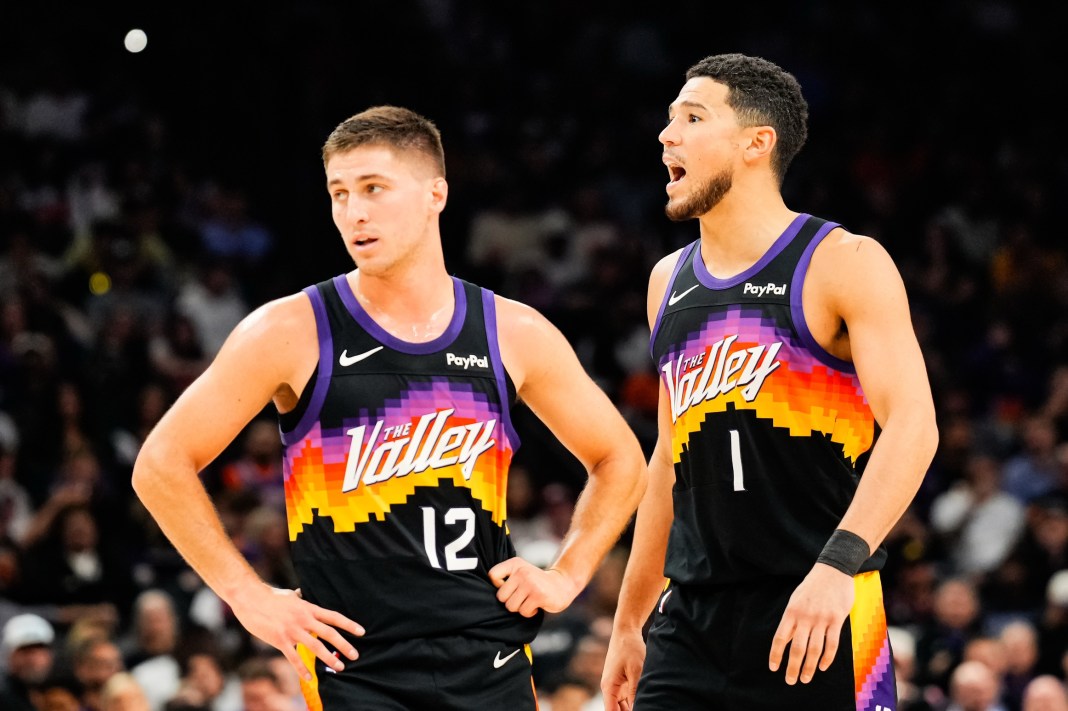
Phoenix emerged last season as a surprisingly competent bunch under head coach Jordan Ott. The Suns won a spot in the Western Conference postseason after a 45-win season and a win in the Play-In Tournament over the Warriors in the winner-take-all meeting. They were eventually swept by the Thunder, but the Suns enter this season with confidence after a strong 2025-26 campaign.
The offseason for Phoenix was largely a quiet one, save a quizzical move in shipping off an unprotected 2033 first-round pick for Miles Bridges, who is on an expiring contract as of this writing. Clearly, the edict is to maximize this roster and make another run at the postseason. The ceiling seems very distant from a championship, but another dalliance with a top seed in the first round of the postseason is attainable for Phoenix this season.
BURNING QUESTIONS
What can Jalen Green do for you?
The acquisition of Green last season was one of the more fascinating ones, but we hardly got to see it work. Due to injury, Green appeared in just 32 games for Phoenix last season. The counting stats were fine — he averaged 17.8 points, 3.6 rebounds, and 2.8 assists on 42.2% shooting from the floor — but he was hardly a positive for the Suns. Their net rating declined by a point per 100 possessions with him on the floor. His usage rate of 31.6% in those 32 games was a career high, but his 10.7 points per 100 shot attempts was a career low. Green was a solid facilitator — he finished in the 86th percentile in assist rate at his position, a career high — but that was one of the few statistics in which he came out looking clean. There is still room for growth here. When Green was on the floor with Devin Booker and Dillon Brooks, the Suns averaged 120.1 points per 100 possessions. If he can rein in the shot selection, there is a diamond in the rough with those three playing together that can be shaped into something beautiful.
What in the world is the point of Bridges?
Bridges is the basketball equivalent of steamed rice: empty calories. Bridges is coming off a season in which he averaged the fewest points since 2020-21 and the fewest minutes per game since 2021-22. But it’s not even the statistical decline, which isn’t even that stark; it’s just that he has never truly improved a team. Despite averaging 17.9 points and 5.8 rebounds per game for Charlotte, the Hornets saw their net rating decline by 5.9 points per 100 possessions with Bridges on the floor. He is a subpar defender who has worsened Charlotte’s defensive rating every season but one in his time in the league. Bridges is also a relatively high-usage player — he has finished in the 75th percentile or higher in usage rate in each of the last four seasons — joining a team filled with already high-usage players. Throw in his contract status, and it is a move that makes little sense for a team that believes it can make a push for a better seed than it had achieved a season ago.
Where do the youths fit in with all of this?
Phoenix does have a fun group of young-ish players with seemingly bright futures on this roster. Collin Gillespie quietly had a very strong season for the Suns, and it led to him locking in a four-year, $48 million contract in the summer. Gillespie upped his scoring average to 12.7 points per game while maintaining a 40.1% shooting percentage from deep. He also finished in the 71st percentile in assist rate, his second consecutive season having achieved that benchmark. Unlike Bridges, he was a massive positive on the floor, improving the Suns’ net rating by 5.1 points per 100 possessions. Ryan Dunn still has some promise to his game, and second-year center Khaman Maluach showed some potential in 46 games last season. The starting five is chock-full of veterans who are there to maximize the potential, but the bench has a lot of young upside. If players like Dunn and Maluach emerge, this team could be much deeper than it was a season ago.
WIN TOTAL RECOMMENDATION: Under 40.5