


How many times does a team that finished tied for the worst record in its conference find itself as a dark horse contender the following season? It has not happened often, but that is the reality in which the Utah Jazz find themselves this season.
Utah finally received some lottery luck in the summer, and with the second-overall pick it elected to take Darryn Peterson out of Kansas. That selection followed a busy trade deadline the season prior, in which the team elected to acquire Jaren Jackson Jr. from the Memphis Grizzlies. Walker Kessler might have been shipped off to Los Angeles, but what remains in the Beehive State is a team with versatile personnel that has the potential to surprise many in a jam-packed Western Conference.
BURNING QUESTIONS
Can this backcourt become one of the best in the Western Conference?
It is an extremely lofty goal for Utah’s guards to achieve the status of “best” in the Western Conference, but the blueprint is there. Keyonte George — who just signed a five-year, $157.5 million rookie contract extension in September — is coming off an incredible season. George was a breakout star for Utah last season. He averaged 23.6 points and 6.1 assists while shooting 45.6% from the floor and 37.1% from deep — all of which were career highs. Peterson plugs in perfectly next to him at the second guard spot. The former Jayhawk provides the Jazz with size in the backcourt — Peterson is 6-foot-5, 200 pounds — and his versatility and ability to play off ball will complement George. It should be noted that the Jazz boast more than those two, though. Remember, Ace Bailey remains on this roster. Bailey averaged 13.8 points and 4.2 rebounds in his rookie season and showed real growth as the season went along. Post-All-Star break, Bailey upped his scoring to 18.3 points per game and improved his rebound (4.9) and assist (2.0) averages. This trio — along with Isaiah Collier and Brice Sensabaugh — gives Utah a backcourt with some insane upside.
Should we be talking more about Bailey?
As previously mentioned, Bailey came on really strong to end the season. Overall, his season was very rookie-coded. The Jazz were outscored by 5.9 more points per 100 possessions with him on the floor, and he finished in the 18th percentile at his position in points per 100 shot attempts. But the youngster really improved as the year went along. Very quietly, he thrived as an offensive rebounder. Bailey finished in the 80th percentile in offensive rebounding rate (5.2%), and when he was on the floor, the Jazz put up 1.9 more points per 100 missed shot attempts. In all of the noise of the offseason that was extremely busy for Utah, it should not be forgotten that the team has a talent it selected fifth overall in last year’s draft who shot 51.7% on two-point attempts and 36.0% from deep over his final 21 games of the regular season.
Will the versatile size that Utah boasts bother foes in the West?
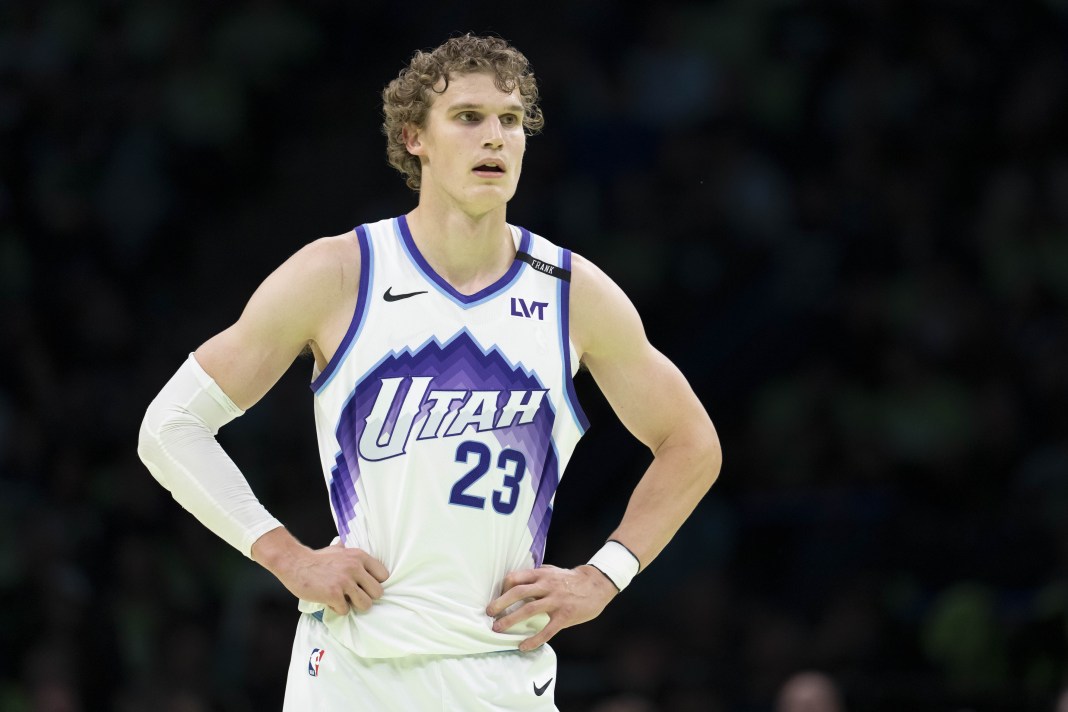
Utah is an extremely large team. The Jazz’s projected starting frontcourt of Jusuf Nurkic, Jackson Jr., and Lauri Markkanen all stand at 6-foot-10 or taller. Will Hardy can play Bailey — 6-foot-9 — alongside them with Peterson at the point in certain lineups. That is a lineup with four players over 6-foot-9, and all five can space the floor. Even Nurkic must at the very least be respected from the perimeter, coming off a season in which he shot 23-of-67 from above the break. The loss of Kessler is a blow to the potential of this group. Kessler would have potentially provided elite rim protection, and his trade means the center rotation will be Nurkic and Jaxson Hayes, which is very thin. But Jackson can play some minutes at the five, and his ability to space the floor will cause issues for opposing defenses. This size and spacing is one of the Jazz’s biggest strengths, and it is why many believe they can be a dark horse in the Western Conference.
WIN TOTAL RECOMMENDATION: Over 36.5