



NFL Conference Championship Betting Trends:
Over the last couple of weeks, I have compiled the key trends and systems overall from recent NFL playoff action, as well as those from both the Wild Card and Divisional Rounds. I have also revealed my annual NFL Champion Shared Traits piece, which showed the Rams, Seahawks, and Patriots as being the most championship-ready teams. All three of those teams are still alive at this point. So far, it’s been a relatively unpredictable playoffs, with hosts and visitors splitting the 10 games so far 5/5.
It’s now time to detail all of the key historical handicapping information for the conference championship round. Will we see Denver and Seattle continue a run of conference title game home dominance? Hosts have gone 19-5 outright over the last 12 seasons in these games, and top seeds work very hard to earn the right to play on their home fields in these all-important contests.
Last week, I finished my Divisional Round article by getting you ready for seeing two matchups this week that might not be expected. However, while not all four home teams won, all the favorites did, so perhaps this Sunday’s games were the expected matchups.
The AFC game comes first on Sunday and is a battle between the conference’s top two seeds. divisional rivals, Denver and New England. You might recall that these two franchises squared off for the 2014 and 2016 AFC titles, both times in Denver, and the host Broncos won both times. Of course, those games were battles between Hall-of-Fame quarterbacks Peyton Manning and Tom Brady. This year’s game will have a completely different feel, as two quarterbacks who’ve never reached this level in the NFL will be squaring off, and furthermore, one of them will be actually taking his first snaps of the season. It’s a matchup of Broncos’ backup QB Jarred Stidham versus Patriots second-year starter and MVP candidate Drake Maye. New England is a 5.5-point road favorite at last check.
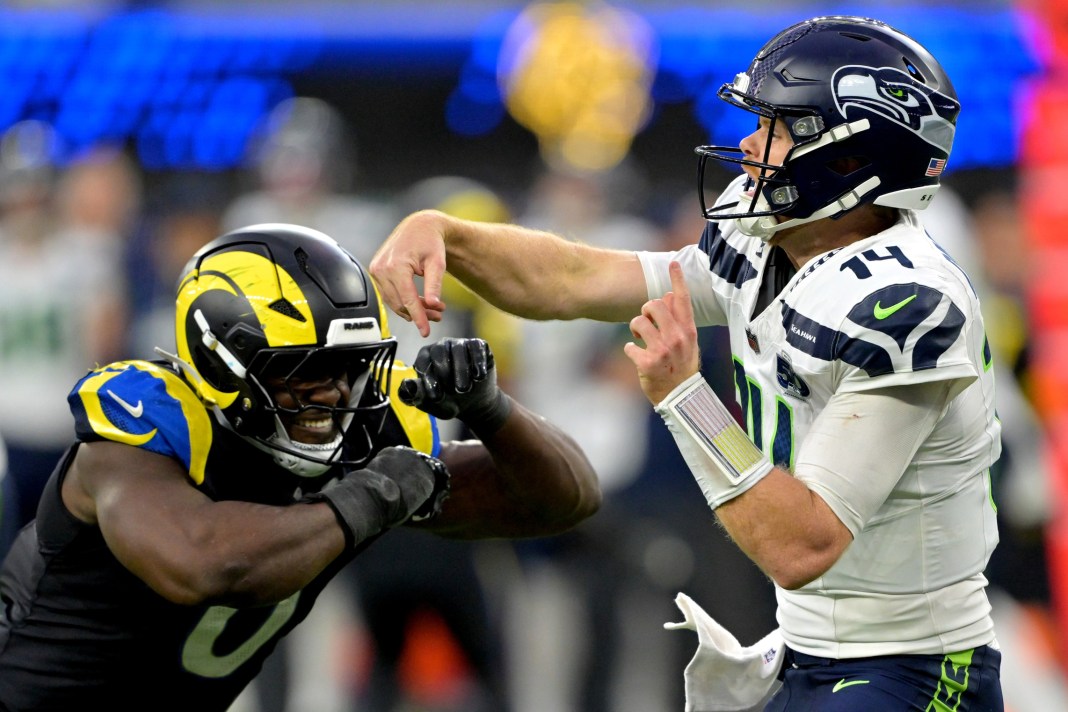
The latter NFC matchup pits divisional foes Seattle and LA Rams, a pair of teams that put on an incredible game in mid-December, one that would eventually decide which team would be the host in this contest. The top-seeded Seahawks, who also faced an NFC West rival in the Divisional Round, will face a Rams’ team that had to survive a pair of 3-point wins on the road to get here. Seattle is just a 2.5-point home favorite. I’ll have more on that in a bit, but the lines for the two games certainly suggest that oddsmakers expect the road teams to be very competitive on Sunday.
A quick glance at recent conference title tilts shows that it is preferable to play at home. Just once in the last 12 playoff seasons have both road teams emerged victorious. However, after last year’s home ATS sweep, home/road teams are split 8-8 ATS in the last eight years.
Using similar methodologies to those of the past two weeks, here are some notable trends and systems that have emerged in recent conference championship game action. I will be applying this year’s matchups (Denver-New England and Seattle-LA Rams) to the key info when applicable.
General Conference Championship Playoff ATS Trends
· The outright winner has covered the point spread in all but seven of the last 48 (85.4%) conference championship playoff games. The most recent team to not do that was in 2024, when San Francisco (-7.5) emerged 34-31 over Detroit after a late Lions score secured the ATS win. If you recall, this is just a bit below the current Wild Card rate of by outright winners but well above the Divisional Round rate.
· Hosts are on a 19-5 SU and 15-9 ATS (65%) run in conference championship play over the L12 years, but hosts/visitors are split ATS in the last two-, four-, five-, seven- and eight-year time windows.
· There have been 10 road favorites in the last 26 years of the conference championship playoffs, and those teams are 6-4 SU and 5-4-1 ATS. Most recently, Minnesota lost in 2018 to Philadelphia, 38-7 as a 3-point favorite. With the injury last week to QB Bo Nix of Denver, New England now finds itself as a 5.5-point road favorite for Sunday. My database goes back to 1992, and there has never been a road favorite of this magnitude in the conference championship round.
· Beware of large home favorites in the conference championship round, at least in terms of laying the points, as those closing as 7-point favorites or more are 13-6 SU but just 6-13 ATS (31.6%) since 1999.
· Conversely, hosts favored by less than 7-points are 19-6 SU and 17-8 ATS (68%) in their last 25 tries. Both smaller home favorites won in 2025, and Seattle will try to add a win to this trend on Sunday.
·Teams that won by 7 points or less in the Divisional Round are just 4-18 SU and 9-13 ATS (40.9%) in their last 22 road conference title game appearances, including Buffalo’s loss at Kansas City last season. The Rams’ 3-point win at Chicago last Sunday puts them in a position to challenge this trend at Seattle on Sunday.
· In intra-divisional conference championship games of this playoff round, the favorites are on a 6-1 SU and 4-3 ATS (57.1%) surge. This will apply to the Seahawks-Rams contest for Sunday, with Seattle the favorite.
· Home teams are 15-4 SU and 12-7 ATS (63.2%) in the last 19 AFC clashes, and 12-6 SU and 8-10 ATS (44.4%) in the last 18 NFC tilts.
· Of the teams in the AFC and NFC Championship contests this year, New England is making its 15th conference title game appearance since 1992 and owns a 10-4 SU and 7-7 ATS record in the prior 14, while Denver is 4-1 SU and 3-1-1 ATS in its last five. The Rams have been in the NFC title game four times since 1992 and have yet to lose in that time span (1-3 ATS). Seattle is also unbeaten at 3-0 SU (2-1 ATS). One of these NFC teams will see their conference title game winning streak extend, the other’s will end.
· Since the 2004 season, playoff experience has meant a great deal to championship hosts. In fact, home teams that were in the playoffs the prior year are on a 26-8 SU and 20-14 ATS (58.8%) run, including 10-2 SU and 7-5 ATS (58.3%) versus teams that weren’t in the playoffs the prior season. These trends will apply in the AFC game, where Denver was in fact in the playoffs last season while New England was not. In the NFC, it is the opposite, as host Seattle was not, but the Rams are a returning playoff team.
Conference Championship Trends by Seed Number
· #1-seeds have been the host teams in 48 of the last 66 conference championship games, and have gone 33-15 SU and 25-23 ATS (52.1%) in those games. Both hosts are #1 seeds for this Sunday.
· #2 seeds hosting conference championship games are just 5-7 SU and 5-6-1 ATS (45.5%) since 1997, although Philadelphia was able to win in blowout fashion versus Washington last season.
· Only three teams that were not #1 or #2 seeds have hosted conference championship games in the last 22 years, and all three won outright while going 2-1 ATS. Indianapolis did so in the AFC in 2007, Arizona followed that up two years later for the NFC, and the Rams won without covering in 2022.
· Wildcard teams, or those seeded #5-#7, have gone just 4-11 SU and 6-9 ATS (40%) dating back to ’96 in the conference title games, including just 2-8 SU and 3-7 ATS the last 14 seasons. The Rams will try to overcome this angle on Sunday.
· Matchups pitting a #1 seed versus a #2 seed in the conference championship games have trended Over the total at a 14-5-1 (73.7%) rate since 2002. This will apply to the Broncos-Patriots contest.
· #1 seeds are on a 9-2 SU and 7-4 ATS (63.6%) surge in conference championship games when hosting any team worse than a #2 seed. This, of course, applies to Seattle.
Conference Championship Trends Regarding Totals
· Since 1993, Over the total is 38-27-1 (58.5%) in the conference championship playoff games. However, there has been a stark difference when you consider conference breakdown lately, as the last 14 AFC games are 9-5 Under (64.3%) while NFC contests are on a 16-7-1 Over (69.6%) surge.
· Breaking down the totals for this weekend’s games based upon ranges, totals less than 45 are on a 10-4-1 Over run, while totals in the 45-48 range are on a 10-3 Over surge. The last 19 games with totals above 48 have gone 11-8 Over. The total for the Broncos-Patriots was a low 42.5, while the Seahawks-Rams was at 46.5 as of Wednesday.
· The last 22 times that a home team has won and covered the point spread in the conference title games, that game has also gone OVER the total at a 16-6 (72.7%) rate. The last 14 times that a road team covered the point spread in conference title action, Under the total is 9-5 (64.3%). This correlation is quite similar to that of the Divisional Round. As I indicated last week, in essence, home teams cover with offense, road teams cover with defense.
Following the Line/Total Moves
In last week’s article, I pointed out that bettors were in fact relatively “sharp” when it comes to Divisional Round games. For the conference championship round, that pattern continues. Following the line moves throughout the week, heading up to the big games would have netted you a record of 19-9 ATS (67.9%) since 2005. Last year, bettors got behind Philadelphia, moving the Eagles from -4.5 opening line favorites to -6. For this weekend, early movement finds New England rising from -4.5 to -5.5 and Seattle bumping up from -1.5 to -2.5. Be sure to follow the moves throughout the rest of the week up until kickoff.
Bettors have also done fairly well with totals recently as well, going 18-10 (64.3%) when moving the totals in the last 28 conference championship games. There has been an upward move in the AFC game and a downward move in the NFC game since opening.
Stats Generated in Conference Championship Playoff Games
· In each successive round so far, it has taken more and more points by the home team to somewhat “ensure” victory, both outright and ATS. That pattern continues for the conference championship round, as the benchmark for success increases to 30 points. Kansas City became the first home team in recent memory to lose with this in 2019, but still, hosts that score 30 points or more are on a 19-1 SU and 17-3 ATS (85%) surge. Those that don’t reach the 30-point mark are 14-14 SU and 8-20 ATS (28.6%) since ’02.
· The magic point total for road teams in conference championship playoff action is even more definitive, however, and that benchmark has proven to be 26 points. Visitors scoring 26 points or more are 13-6 SU and 15-4 ATS (78.9%) when they reach that mark since 1992. When scoring less than 26 points, the record of the road teams has dropped dramatically to 10-37 SU and 17-29-1 ATS (37%) since 1992. However, on that last trend, Buffalo put up 29 in a 3-point loss at Kansas City last January.
· Teams that gained more first downs in their respective conference championship games are 21-8 SU and 19-10 ATS (65.5%) over the last 16 years in those games. There have been three first-down ties, including the 2019 NFC game. You will see later that big plays prove more important than first-down volume.
· Teams that controlled the time of possession are on a 32-12 SU and 33-11 ATS (75%) run in the conference championship playoffs since 2003. This is obviously a critical factor.
· Conference championship playoff teams that gained more yards rushing in those games are 31-13 SU and 32-12 ATS (72.7%) over the last 22 seasons. Strangely, at the same time, teams that rush for more yards per attempt in a conference championship playoff game are just 18-26 SU and 21-23 ATS (47.7%) in that same span.
· Putting up big passing numbers in conference championship playoff games has also proven a key ingredient to success, since those teams are 30-16 SU and 31-15 ATS (67.4%) since 2002. Even better, teams that gained more yards per pass attempt in a conference championship playoff game are 34-12 SU and 33-13 ATS (71.7%) during that same stretch.
· Going back to 2003, teams that turn the ball over fewer times in a conference championship are on an impressive 33-5 ATS (86.9%) run, although most recently, the Chiefs did survive a turnover deficit in edging Buffalo in 2025.
Teams’ Regular Season Won-Lost Record Trends
· There have proven to be significant differences when it comes to the success rates of conference championship teams based upon their regular season records, or the comparison between their record and their opponent’s. For instance, here are the records of home teams based broken up by regular season wins: Home teams that won 14 or more games in the regular season were 11-1 SU and 9-3 ATS (75%), home teams with 12 or 13 regular season wins were 19-13 SU and 13-19 ATS (40.6%), and hosts that won 11 or fewer games were 3-1 SU and ATS. The regular-season win totals for the home teams this year were both elite, 14 for both Denver and Seattle.
· Road teams that won 12 or more games in the regular season are 3-17 SU and 7-13 ATS (35%) in their last 20 conference title games, road teams with 11 regular season wins were slightly better at 7-9 SU and 9-7 ATS (56.3%) in that same span, and ironically, those visitors that won the fewest games, 10 or less, were nearly as good outright at 5-7 SU and 7-5 ATS (58.3%). The Patriots won 14 games and the Rams won 12 in the regular season.
· Home teams that won at least two more games during the regular season than their conference championship playoff opponents are only 14-8 SU and 10-12 ATS (45.4%) since 2002. This trend applies to the NFC and the contest on Sunday.
· When just one regular season win separated two conference championship playoff opponents, or the records were equal, the home teams are 16-4 SU and 13-7 ATS (65%) over the last 17 seasons. This angle applies to the AFC game, where both New England and Denver were 14-3.
Teams’ Regular Season Offensive Statistics Trends
· Teams that scored more points per game during the regular season are on a 23-13 SU and 18-18 ATS (50%) run over the last 18 conference championship playoff seasons, but just 2-8 ATS in last 10 games. For the second year in a row, both 2026 edges here belong to the road teams.
· The ability to run the football has been much overrated when it comes to conference championship success. Teams who averaged more rushing yards per game are 21-27 SU and 22-26 ATS (45.8%) since 2002. However, these teams are on a 14-6 ATS (70%) surge currently. Similarly, those that averaged more yards per rush are just 13-21 SU and 15-19 ATS (44.1%) over the last 17 seasons. The Patriots and Rams hold the edges in these categories for Sunday.
· Passing yardage has meant much more than rushing yardage in terms of conference championship playoff success, with teams owning an edge in total offensive passing yardage going 30-16 SU and 27-19 ATS (61.3%) over the last 23 seasons in this playoff round, but were 0-2 last year. More efficient passing yards per attempt teams were a bit worse at 27-19 SU and 24-22 ATS (52.2%). This latter category was clearly more important in earlier rounds. Again, the Patriots and Rams own the edges in both categories, with each leading their respective conference in total passing yardage.
· Teams that generated more yardage overall offensively in the regular season own a slight edge when it comes to conference championship playoff success, going 27-17 SU and 22-27 ATS (50%) over the last 22 seasons. There is a slight 10-8 ATS edge recently as well. Give this edge to the Rams and Patriots.
· The offensive yards per play statistic has also proven somewhat important, as teams with an edge in that offensive category are 26-14 SU and 21-19 ATS (52.5%) over the last 20 years on championship Sunday. There is a 10-7-1 ATS edge recently. Again, count the Rams and Patriots as the beneficiaries should this statistical trend continue.
· Offensive yards per point has not proven to be an effective statistical indicator, as teams who have averaged fewer yards per point are just 21-19 SU and 15-25 ATS (37.5%) in the conference championship playoff round since 2005. This includes ATS losses in nine of the last 10 games. If you’re wondering, these “edges” go to New England and Seattle.
· The offensive turnovers statistic provides the handicapper very little edge, since teams that turned the ball over fewer times in the regular season than their opponent are only 22-19 SU and 20-21 ATS (48.8%) since ’04 in conference championship games. These teams are on a 13-8-1 ATS run in the last 11 seasons, so note again that the Patriots and Rams had fewer giveaways in the regular season.
· Teams that converted third-down opportunities more efficiently in the regular season are 19-15 SU and 17-17 ATS (50%) in the last 34 conference championship games.
Teams’ Regular Season Defensive Statistics Trends
· Teams that allowed fewer points per game during the regular season are 18-13 SU and 19-12 ATS (61.3%) dating back to 2010 in conference championship games, providing what would be a nice edge to handicappers. Denver and Seattle hold edges over their counterparts in this key statistical area.
· Defensive rushing yards is becoming a more insignificant stat when it comes to handicapping conference championship action, 20-18 ATS (52.65%) over the last 38 games, as has yards per rush defense, as teams with an edge in that stat are 24-22 SU and 27-19 ATS (58.7%) since 2003, and 13-7 ATS in the last 20. Edges in both: Denver and Seattle.
· Conference championship playoff teams with an edge in defensive passing yardage allowed over their opponent are 29-17 SU and 30-16 ATS (65.2%) over the last 23 seasons in this round. Teams with the edge in defensive pass efficiency share the same 29-17 SU and 30-16 ATS mark. Denver and New England hold both edges, with the teams being the top-ranked in the NFL in YPA.
· Teams that allowed less yardage overall defensively are 28-18 SU and 29-17 ATS (63%) in the AFC and NFC title games since 2003, while those that held an edge in yards allowed per play share the same 28-18 SU and 29-17 ATS record. Advantages to Denver and Seattle.
· Defensive yards per point should be given at least some consideration for conference championship Sunday, since teams with an edge there are 10-24 ATS (29.4%) over the last 34 games. Fading these teams has been a sound strategy, it seems. If curious, New England and Seattle were the better teams in Defensive YPPT in each conference.
· If you recall, the Divisional Round trend concerning teams forcing turnovers was very distinctive. Not the same for this weekend, as teams that had more takeaways in the regular season than their opponent are just 23-22 SU and 22-23 ATS (48.9%) since 2002 in conference championship play.
· Teams that stopped third-down opportunities more efficiently in the regular season are on a mediocre 21-25 SU and 22-24 ATS (47.8%) run in the last 46 conference championship games. However, they are on a 6-2 ATS run currently.
Summary
The first two rounds of the NFL playoffs have seen a split in home and road wins, although hosts did stick to their annual three out of four victories trend in the Divisional Round. Make no mistake, especially in the expanded playoff era with just the top seed getting a bye, teams work hard to earn the right to host these games. That said, winning these games puts teams on the ultimate football stage, and there is a lot of pressure that comes with that. There is no shortage of motivation on either side.
Playing the statistical advantages of teams has paid off for bettors somewhat, and the stats that have proven to mean more have been from passing offense and overall defense. For the AFC game, Denver is clearly the better defense statistically, but they will be without their starting quarterback. Does that negate the defensive edges? In the NFC, Los Angeles has been slightly better offensively, Seattle slightly better defensively. Do you trust Seahawks’ QB Sam Darnold over the Rams’ Matthew Stafford? It would seem that this game result hinges a lot on that matchup.
Sometimes we tend to overcomplicate things at this time of year as we look for the golden nugget. If you’re looking for some questions to ask yourself to start handicapping these games, go with these.
Is the host playoff experienced?
Where is the money going?
Which team has the better quarterback?
Which team is playing better RIGHT NOW?
Which team gets after the opposing quarterback better?
If the playoffs so far have demonstrated anything, it’s that the answers to these questions are key.
You can find my more detailed thoughts on both games in a separate Best Bets article to be published on VSiN in the next day or two. Of course, that will come after we release our much-anticipated VFL Analytics Report for the championship tilts.
Whatever method you use to eventually decide your plays for this weekend, good luck, and we’ll see you back in the next couple of weeks as we uncover all of the key betting angles on the Super Bowl!