



There’s always something worth digging into when it comes to the NBA. Every Tuesday, I’ll use this space to dive into three things that have caught my attention, whether it’s a team that’s better than its reputation, a trend I’m buying, or something that isn’t working.
Welcome to “Three in the Key.” This week, I’m making the modest case that the Pelicans don’t stink, looking at what’s allowing the Pistons to keep winning, and trying to figure out what the hell is going on with the Suns.
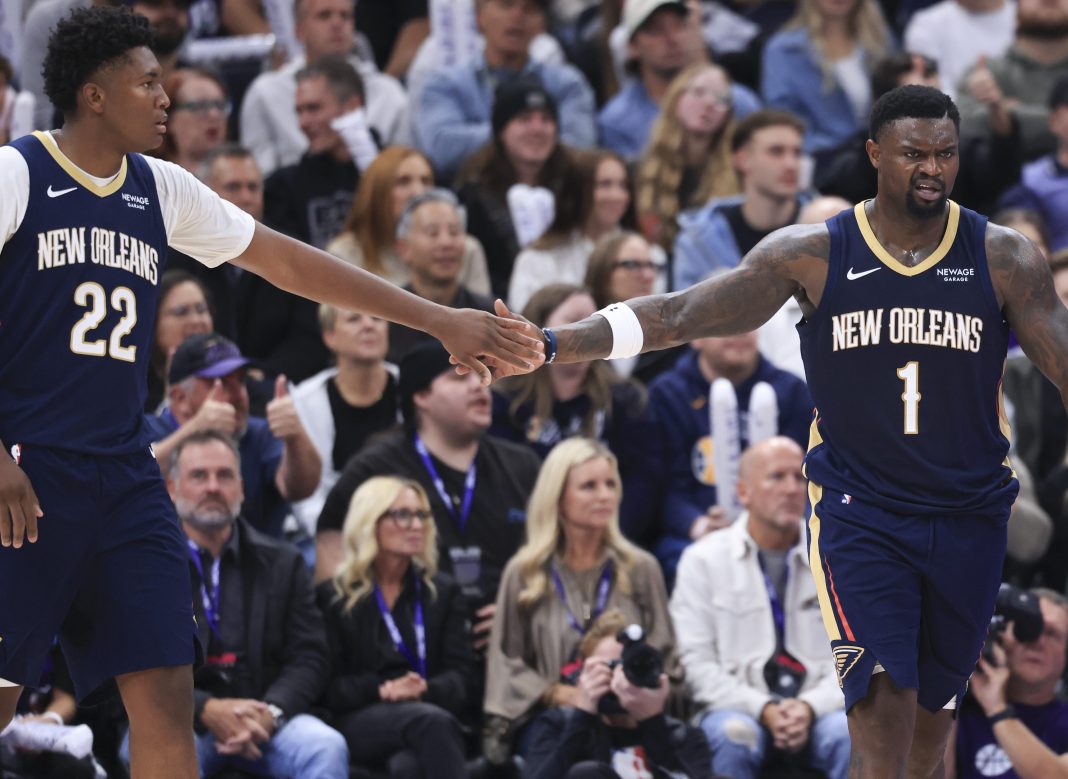
New Orleans Pelicans: Better Than You Think?
“Here we go again” was probably the common sentiment surrounding the Pelicans after an 0–4 start. Since then, New Orleans is 3–0 with an efficiency differential of +12.7, according to Cleaning the Glass. During that winning streak, the Pelicans are scoring 121.2 points per 100 possessions and allowing just 108.5. One of those wins came against the Kings, so feel free to downplay that. But New Orleans followed it by beating Atlanta, then went into Memphis and knocked off a good Grizzlies team in overtime. Those count for something.
What seems real is the Pelicans’ ability to beat teams with pace, particularly when they go small. New Orleans currently ranks third in the NBA in possessions per 48 minutes (104.8), according to Dunks & Threes, and the team has been playing even faster recently.
With Yves Missi injured, the Pelicans are leaning more heavily on Derik Queen, a dynamic offensive player who has had his struggles on the defensive end. Queen had his moments as a rookie last season, showcasing the touch, feel, and instincts that made him a first-round pick. But his defensive limitations made it difficult for then-head coach Willie Green to build sensible lineups around him. At times, playing Queen alongside Zion Williamson looked borderline impossible.
In the 1,158 possessions they shared last season, New Orleans allowed 122.8 points per 100 possessions. For context, Washington finished last in the NBA in points allowed per 100 possessions with that exact mark.
This season, the Pelicans are allowing just 109.8 points per 100 possessions with Queen and Williamson together. Zoom out a little further, and New Orleans is giving up only 108.7 points per 100 possessions with Queen on the floor.
Queen hasn’t suddenly turned into Ben Wallace. The 21-year-old isn’t a high-energy, rim-protecting big man, and a few encouraging games won’t erase the physical limitations that come with being shorter and slower than most centers. But Jamahl Mosley has raised the level of accountability in New Orleans, and Queen has responded with better defensive engagement. He’s doing enough to stay on the floor, and that means his high-level offensive skill isn’t going to waste.
The changes go beyond Queen. Mosley has put more of the offense in Jeremiah Fears’ hands. It’s been the second-year guard’s show lately, and he’s running with the opportunity. Mosley has also moved Herb Jones and Karlo Matkovic into the starting lineup, giving New Orleans a different look on both ends.
Suddenly, the Pelicans have some interesting combinations. Last year’s rookie duo of Fears and Queen is producing, and Williamson looks fully bought in on both ends. All of that matters when you consider this team already had a highly coveted wing duo in Trey Murphy III and Jones.
What does it all mean? Maybe nothing. It’s early, and making the Play-In Tournament is probably still the best-case scenario for the Pelicans’ 2026–27 season.
But you know what? New Orleans is 5–2 against the spread. The NBA is filled with miserable teams, some operating like tankers in a year in which tanking is discouraged. The Pelicans don’t belong in that conversation.
New Orleans could be a profitable ATS team the rest of the way, and going Over its regular-season win total of 27.5 no longer seems far-fetched. Maybe things are finally moving in the right direction for a franchise that hasn’t given anyone much reason for optimism lately.
Detroit Pistons: What’s Driving Their Continued Success?
It was fair to wonder whether the Pistons were as good as their record last season. Detroit went from 44 wins in 2024–25 to 60 last year, and the team did it without a clear No. 2 option alongside Cade Cunningham.
So far, Detroit hasn’t given anyone much reason to believe it was a fluke. The Pistons are 6–1 after going into Charlotte and beating the Hornets 124–91 on Monday, and five of their first seven games have been on the road. This isn’t a case of a good team feasting on a cupcake home schedule. Detroit is just flat-out good, and the team will soon get to play at Little Caesars Arena more frequently.
The Pistons are relentless defensively. They’re allowing only 103.1 points per 100 possessions, the best mark in the NBA and an improvement on last year’s 109.5. Some of that might have to do with the soft offenses Detroit has faced, but the bones of last year’s hard-nosed team remain. Cunningham plays better defense than most alphas in this offense-driven league, and he has some absolute dogs around him.
Ausar Thompson remains one of the league’s most impressive lockdown options, capable of taking away an opponent’s top scorer on any given night. The Pistons also have a bunch of players who understand the importance of playing with physicality, communicating through switches, and applying pressure both on and off the ball. They don’t just make you miss. They make it hard for you to run your offense — or even breathe.
Detroit is also putting more trust in Thompson and Duncan Robinson offensively. I still strongly believe the Pistons need to make a move for another creator — even someone like Tyler Herro or Zach LaVine would suffice — but they’re getting more out of their non-Cunningham options. Thompson’s jumper is still a mess, but he has increased his assists per game from 3.1 to 5.0. Meanwhile, Robinson is averaging a career-high 17.9 points, launching from three whenever he has an inch of space and making a quick, meaningful pass when the shot isn’t there.
That matters for Cunningham. Having players who can create an advantage, keep the ball moving, or punish a defense for helping gives him more opportunities to finish possessions without having to do all the work himself. The Pistons still need another dependable weapon, but they’re finding ways to make life easier for the one they have.
It should also be mentioned that Detroit is doing all of this with Jalen Duren sidelined. It helps that Paul Reed is putting up Most Improved Player-type numbers, averaging 13.4 points, 6.7 rebounds, and a combined 2.2 steals and blocks per game while providing infectious energy on both ends. But even Reed’s production gets back to the bigger point: Detroit is a machine that keeps operating smoothly, even when you give it reasons to freeze up or blow up.
With that in mind, the Pistons aren’t going anywhere. They should be in position to have home-court advantage in the Eastern Conference playoffs, and I fired on them to lead the NBA in regular-season wins at 30–1 a couple of days ago. Beyond that, they’re lurking as a legitimate contender to represent the East in the NBA Finals. They just need president of basketball operations Trajan Langdon to land another solid piece of the puzzle.
Phoenix Suns: Why Are They Struggling?
The Suns were one of last season’s pleasant surprises, and owner Mat Ishbia entered this season hoping to see his group take another step forward. Welp. Phoenix is now 1–4 after letting a 17-point lead slip away in Monday’s 116–113 loss to Golden State, and this team isn’t doing enough of the simple things required to win NBA games.
The defense is the biggest issue. The Suns, who have spent two years bragging about their improved culture, are last in the NBA in raw defensive rating (124.0). Their starting five of Devin Booker, Jalen Green, Dillon Brooks, Miles Bridges, and Khaman Maluach is allowing 135.2 points per 100 possessions, the worst mark of any five-man unit in the league. It’s a small sample, but nothing about the way this group is playing makes that number easy to dismiss.
Phoenix isn’t closing out on time, players are losing track of cutters, and even when the Suns force a miss, they can’t finish the possession with a defensive rebound. Some of that comes with playing Brooks and Bridges together at the forward spots. They’re giving up size, and neither helps matters by spending too much time watching the ball instead of finding a body.
It also doesn’t help that Maluach looks unprepared for life as a starting center. There’s a difference between having the physical tools to protect the paint and knowing how to anchor an NBA defense, especially when the guys in front of you aren’t doing their jobs. Maluach hasn’t looked ready for that responsibility.
To the surprise of many, Phoenix is missing Mark Williams, who averaged 11.7 points and 8.0 rebounds last season. Plenty of people wanted the Suns to let him walk in free agency, clearing the way for more minutes for Maluach and Oso Ighodaro. That sounded a lot better before Phoenix had to live with it.
The reality is that this Suns team has plenty of bark and very little bite. Brooks is willing to mix it up with anyone, anytime, but Phoenix lacks real, purposeful toughness.
The Suns are also getting next to nothing from Green. Nobody expects the former Rockets guard to meaningfully defend, but he’s at least billed as a microwave scorer. Phoenix isn’t getting that, either. Green is averaging 11.0 points while shooting 41.8% from the floor and 22.2% from three. If he isn’t scoring, there just isn’t enough else in his game to justify what he’s giving back on the other end. Right now, he’s killing them.
Then there’s Booker. This roster is flawed in a number of ways, but he still deserves a ton of blame. He scored three points in a blowout loss to Oklahoma City, then fouled out after some miserable late possessions against Golden State. The Suns desperately need him to be an efficient scorer and someone who can manage games. They can’t afford for their best player to disappear one night and unravel late in another.
Right now, Booker looks a little too much like the “empty-calorie” player his critics believed he was earlier in his career. That doesn’t erase what he has accomplished since then, but it makes the current version awfully difficult to defend. His contract pays him to be the solution to problems like these, not another one of them. If this is what Phoenix is getting, that deal belongs in any discussion of the league’s worst.
The good vibes from last season have come and gone. All offseason, I tried to identify teams that could completely underwhelm and significantly undershoot their win totals. This could be one of them.
The Suns need to find out whether a change to the starting lineup can give them a more functional mix. Otherwise, they need to explore a trade. Phoenix can use someone who can organize the offense, help finish defensive possessions, or bring some structure to a team that has very little of it. Perhaps a little Dejounte Murray or Domantas Sabonis could make this dish more palatable.