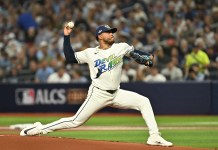



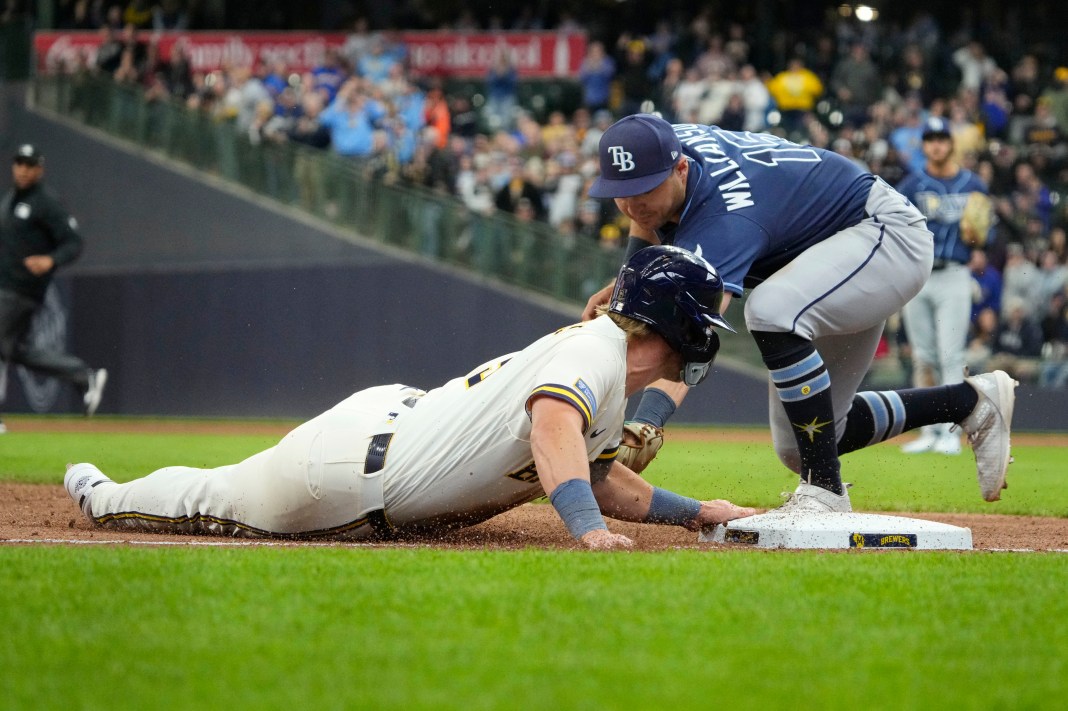
The 2026 World Series is a really fun matchup between two organizations that have maximized their spending and have been some of the most innovative and savvy in all of sport, especially baseball. Unfortunately, the Rays vs. Brewers World Series is sure to be bastardized into some kind of CBA-related argument, as the Rays rank 28th in Cot’s Contracts’ Year End 40-man rankings and the Brewers rank 19th, but haven’t been higher than 13th in the league in that department dating back to 2000. See?! Small-market teams can win!
Jensen Lewis and I examined the payrolls of World Series teams way back in our MLB Betting Guide in February and the lowest-ranked payroll since 2012 to win the Fall Classic was the 2017 Astros, who became a hell of a lot more expensive right after, a path that the Brewers are trending towards, even though they’ve been very astute about locking in their standout youngsters before they become MLB stars. Most of the teams in that survey, as you would expect, were top 10 in payroll and many were top five.
I hope we can save the schlong-measuring contest between the MLBPA and the MLB Owners until after the World Series is finished, as this series deserves to be appreciated for what it is instead of what it means for the future of baseball. These were two best teams in baseball during the regular season and they’ve been the two best teams in their respective leagues, with Milwaukee boasting a 7-1 record and Tampa at 7-2. The Rays swept the Yankees in the ALDS, which was very impressive, but the Brewers sweeping the Dodgers in the NLCS was maybe the most dominant playoff performance we have ever seen from an underdog.
So, that’s our matchup and this is one for the nerds like myself. These two teams win by winning at the margins. They find edges within their payroll constraints and often do things that are mirrored by the rest of the league when they catch on. In a sport where failing 65-70% of the time is just expected, the Rays and Brewers dig into the data more than other organizations to find out how to set themselves up for success. All of that hard work still requires the players to produce in those key situations, but all of that hard work has finally resulted in a World Series appearance for the Brewers, their first since 1982, and first for the Rays in a non-COVID season since 2008.
Rays vs. Brewers World Series Betting Odds
Milwaukee Brewers -160 // Tampa Bay Rays +140
Total Games: Over 4.5 (-800/+600); Over 5.5 (-180/+150); Over 6.5 (+205/-245)
Rays vs. Brewers World Series Schedule
Game 1 @ MIL: Friday, October 23 at 8 p.m. ET (FOX)
Game 2 @ MIL: Saturday, October 24 at 8 p.m. ET (FOX)
Game 3 @ TB: Monday, October 26 at 8 p.m. ET (FOX)
Game 4 @ TB: Tuesday, October 27 at 8 p.m. ET (FOX)
Game 5 @ TB: Wednesday, October 28 at 8 p.m. ET (FOX)*
Game 6 @ MIL: Friday, October 30 at 8 p.m. ET (FOX)*
Game 7 @ MIL: Saturday, October 31 at 8 p.m. ET (FOX)*
Rays vs. Brewers Offense
Slight Edge: Brewers
This is a fascinating offensive series. While we saw Junior Caminero and Yandy Diaz hit two-run homers in Game 6 to propel the Rays to the World Series, that is rarely their style of scoring. Tampa struck out at a lower rate than any other team and batted .258/.326/.402. The only team with a higher batting average was the Brewers, who struck out 22% of the time compared to Tampa’s 18.8% of the time. But, the Brewers also had a BABIP that was 20 points higher and led the league at .316.
The Rays may benefit from facing two teams that actually hit for less power than they do, as their 169 homers ranked 22nd, but the Red Sox, Guardians, and Brewers were the three playoff teams that hit fewer long balls. That said, even though Milwaukee hit 15 fewer homers, their .403 SLG was one point higher than Tampa’s at .402, as the Brewers hit 49 more doubles and four more triples.
One of the main reasons why the Brewers carried such a high BABIP is because they only had an 8.4% pop-up rate. Conversely, the Rays had a 13% pop-up rate. Both teams had 143 infield hits, as only the Pirates had more, but the Rays also led the league by a mile in bunt hits with 49. Milwaukee was second with 32.
As I said above, these are the two most innovative teams in baseball. In an era where everybody is obsessed with launch angle and pulling the baseball to increase hit probability as much as possible, the Brewers and Rays were 30th and 29th, respectively, in Pull%. The Brewers also hit the lowest percentage of fly balls by 2%. The Rays were 26th in that department. Nobody hit the ball more to the opposite field than the Brewers. Nobody hit the ball more to the opposite field than the Brewers and Rays.
We can call it a set of coincidences if we want to show that these two offenses mirror each other in a lot of ways stylistically. However, there were some very big differences between the two teams during the regular season. The Brewers had the lowest Swing% in baseball at 43.8% and the lowest Chase Rate at 26.6%. The Rays were 19th in Swing% at 47.2% and 14th in Chase Rate at 30.4%. Milwaukee led the league in BB% at 10.6%. Tampa was 22nd at 8.4%. But, like I said, the Rays struck out at the lowest rate of any team. The Brewers were 17th in K%.
Because of the walks, Milwaukee had 2,090 baserunners via hit or walk. Tampa had 1,919. The Brewers scored 832 runs, while the Rays scored 736. With fewer baserunners, the Rays also hit into 12 more double plays. The park factor is a thing here, as American Family Field is a better offensive park than Tropicana Field. But the way that these two teams reached base was pretty different. Tampa had a contact-first approach. The Brewers made a decent rate of contact, but made a lot of really strong swing decisions.
Even though Milwaukee had such a low rate of fly balls to drag down their Barrel% to 7.3%, that was still 1.6% higher than the Rays, who were among the league’s worst at hitting the best type of contact. Milwaukee was also seventh in Hard Hit%, while Tampa Bay was 29th.
As far as playoff performance goes, the Brewers have slashed .250/.343/.396 in the postseason, while the Rays have slashed .232/.293/.356. The Brewers have gone full Adam Dunn here with the three true outcomes. They have 71 strikeouts, 34 walks, and 10 homers in their eight games. The Rays have 66 strikeouts, 21 walks, and seven homers in their nine games.
I think we can definitively say that the Brewers have the edge offensively in this series, but it’s only a slight edge to me because…
Rays vs. Brewers Pitching
Edge: Neither
The Rays pitching staff had the lowest BB% in the league at 6.9%. They were the kings of forcing teams to hit their way on base. Along with limiting walks, opponents only batted .225 against the Rays during the regular season. Only the Dodgers, Brewers, and Yankees were better in that department and all three of those teams had much higher K% marks than the Rays.
This is strength on strength in that regard. Rays pitchers didn’t walk batters and the Brewers are looking to walk. Rays hitters didn’t strike out and the Brewers are looking for punchouts, as they led the league with a 25.8% K%. The Rays were 14th at 22.3%. Milwaukee had the third-highest SwStr% (swinging strike percentage) as a staff, but the Rays offense had the lowest SwStr% at just 8.6%. Interestingly, despite the higher K% as a group, the Brewers only had a 9.6% SwStr% offensively.
With the long gap between games, both teams will have their rotations set up and their bullpens will be well-rested. That means Drew Rasmussen vs. Jacob Misiorowski in Game 1, Freddy Peralta vs. Logan Henderson in Game 2, Robert Gasser vs. Griffin Jax/Nick Martinez in Game 3, and then we’ll see where things go from there.
No team leveraged changeups at a higher rate than the Rays. The Brewers were fourth in Batting Runs Value against changeups per Statcast. Tampa also had top-10 usage of sinkers, a pitch that the Brewers, and many teams around the league, struggled against. For the Rays to have a good chance at pulling the upset in this series, they probably need one of the Misiorowski or Henderson games. Rasmussen is a heavy sinker user. Peralta throws a lot of high fastballs, possibly a useful strategy against a lineup that doesn’t like to elevate the baseball much.
Speaking of Misiorowski, is he tired or has he just had a couple of tough assignments? The NL Cy Young Award winner has allowed three earned runs in 8.1 innings with an 11/4 K/BB ratio and nine hits allowed. The Padres hit a million foul balls off of him in the NLDS and the Dodgers made him work in the NLCS, limiting him to just 4.1 innings, as he walked three and struck out five. Henderson gave up four runs in his start against the Dodgers. The Brewers won both of those games anyway, but it wasn’t easy.
Henderson only has six strikeouts in his nine innings. The Rays are probably not going to strike out as much in this series as an average team would against Milwaukee, so that makes Game 1 and Game 2 really interesting because the success experienced by Miz and Henderson will be more BABIP-dependent than usual. Similarly, because the Brewers won’t draw as many walks as normal, their results will be dependent on what batted balls do.
These are two extremely solid bullpens. The deeper the series goes, the less effective relievers end up being. What really helped the Rays against the Guardians is that Cleveland got next to no length from Parker Messick and Gavin Williams had a five-and-fly. Cleveland needed 40 innings out of the bullpen and guys got fatigued and also less effective as the Rays got more plate appearances against them. The Brewers will have to avoid this scenario, either by getting some length from the starters or by using different arms in different spots. Stephen Vogt didn’t really have that luxury. Pat Murphy has a deeper relief corps.
Kevin Cash got away with leaving Jax in for Petey Halpin’s Game 3 home run, as that was really the only enormous pitching mistake he made. Otherwise, I thought he used his relievers well. It is interesting that Bryan Baker is exclusively a one-inning guy for him, whereas other managers are willing to stretch their closers for multi-inning outings, both during the regular season and the playoffs. That makes guys like Ian Seymour, Tyler Wells, Kevin Kelly, and Cam Booser hugely important in this round.
All in all, while Miz is the Cy Young winner and the Brewers bullpen was lights out against the Dodgers, where Rasmussen is and what the Rays have done to improve Peralta closes the gap quite a bit.
Rays vs. Brewers Miscellaneous Notes
Like I’ve said multiple times, the Rays are a contact-oriented offense and a contact-oriented pitching staff. Balls in play and sequencing with runners in scoring position will decide this series. Unsurprisingly, these were the two best teams in batting average with RISP, with the Rays at .284 and the Brewers at .276. The Brewers did draw a higher rate of walks and hit for more power, but the Rays struck out less and had a higher walk rate in those high-leverage spots than they did overall.
Tampa has played exceptionally well defensively in the postseason, but they were only +7 Outs Above Average with 11 runs prevented during the regular season. The Brewers were +21 Outs Above Average with 18 runs prevented. Defense will play a huge part in how this series shakes out.
The other big factor here is catcher defense. The Rays really controlled Cleveland’s running game, whereas the Rays were 8-for-8 in stolen bases against Guardians catchers. Milwaukee is 10-for-12 stealing bags in the playoffs. William Contreras was +5 Caught Stealing Above Average during the regular season, but so was Patrick Bailey and the Rays ran on him. Liam Hicks had only thrown out five of 26 baserunners and 11 of 69 in total during the regular season, but he and Nick Fortes did well against Cleveland.
Rays vs. Brewers World Series Prediction
I think the Brewers win the World Series, but -160 is a little bit higher than I’d like to pay. I was thinking they’d be in the -140ish range. But, you certainly have to account for the optics of sweeping the Dodgers and also beating a Padres team that was arguably the best in baseball down the stretch. To me, they just have too many good ballplayers and guys with the ability to hit the ball hard. The Rays #GuardsBalled Cleveland to death with seeing-eye singles and bloopers before the two big Game 6 homers. That’s what contact does for you. That’s why Cleveland won the division and made the playoffs. They do that same thing.
The Brewers make a lot of contact, too, but also pair it with a high walk rate and a lot of dangerous baserunners. Frankly, the Brewers are a way better version of the Guardians and a better version of the Rays. I think we’ll have some really close games in this series and a hit here or there will determine the outcome, but I trust the Brewers to have the better plate appearances and cash in more of those chances.
DraftKings lists the Game 1/Series Double at +125 for Milwaukee, but if you look at -162 and -160 as a parlay, it pays +163, so that’s a pretty poor price being offered. I do think that’s how the series plays out, as Milwaukee has looked so incredibly prepared for every game of the postseason. I think they win Game 1 and do ultimately win the series. I’m just not quite sure how to best represent that position heading into the series. But, with this posted on Tuesday morning and the series not starting until Friday, there’s time to think about it.
Pick: Brewers
Rays vs. Brewers World Series MVP
For the Rays, my favorite pick would be Yandy Diaz at +1000. He has the best approach for high-velocity right-handers with how much he likes to go to the opposite field, and he’s always hit lefties well. The Rays also got a lot of scrappy plate appearances from the bottom of the order against Cleveland that gave Yandy some chances with men on base. Against a high-velo pitching staff, I think it would be his success that plays a huge part if the Rays win.
For the Brewers, I like Brice Turang at +900. Turang was an above average hitter against changeups and cutters, which should match up well with the Tampa pitching staff. Also, we’ll see how Cash leverages the late innings and how he matches up with Turang, but with all right-handed starters coming in Rasmussen, Peralta, Jax, and Martinez, it helps that Brice hit .291/.392/.510 against righties with a .390 wOBA and a 149 wRC+. He had a 45.4% Hard Hit% and an 8.9% Barrel% in that split. He didn’t have a great second half after a strong first half, but I think he matches up well here.