

Only the guys with gray hair and those who have lost their hair can remember when the Dallas Cowboys were great. It has been more than 30 years since the Cowboys won the Super Bowl, and I’m old enough to vividly recall that night on January 28, 1996, when owner Jerry Jones celebrated the third title in four years for “America’s Team.” Jones was driving the Cadillac of NFL franchises — before falling asleep at the wheel and steering it into a ditch.
VSiN host Dave Ross, a die-hard, gray-bearded Cowboys fan, is an eternal optimist who seems to never stop smiling. But when reminded of Dallas’ championship slump that has reached three decades, “Super” Dave’s demeanor quickly deteriorates and takes a turn for the worse.
But it’s time to turn those frowns upside down, at least for the offseason, because Dallas ranks as one of the biggest winners of last week’s NFL Draft. Not No. 1 in the rankings, but close to it. Jones and the Cowboys’ scouts have shown surprising competence in most drafts and they produced another strong class this time, led by first-round picks Caleb Downs and Malachi Lawrence on the defensive side.
Downs, a safety who started his college career at Alabama and finished it at Ohio State, makes plays all over the field and is outstanding against the run and pass. Downs was rumored to be loved by the New York Giants, but they passed on him at No. 10 and the Cowboys wisely snagged him with the 11th pick. ESPN draft analyst Matt Miller ranked Downs as the top defensive player in the draft. Lawrence, an edge rusher from UCF, was the pick at No. 23 after Dallas traded down three spots in a deal with Philadelphia. It’s fair to question the logic of trading with Eagles general manager Howie Roseman, who’s about as sharp as it gets, and time will tell who won the swap.
After trading Micah Parsons, one of the league’s best pass rushers, to Green Bay last season, Dallas needed to make defense its top priority. The Cowboys also took edge rushers Jaishawn Barham (Michigan) and LT Overton (Alabama) in later rounds.
In January, the Cowboys hired 34-year-old Christian Parker, who was on the Eagles’ staff, as their new defensive coordinator. Parker should prove to be a smart hire, but he’s got a lot of work to do. Dallas ranked last in the NFL in scoring defense (30.1 ppg) last season. The Cowboys’ high-powered offense can outscore most opponents, but they won’t field a championship-contending team until the defense dramatically improves. The Downs pick was an ideal move to begin the defensive upswing.
As Jimmy Johnson, Dallas’ former two-time Super Bowl-winning coach, once said, “How ‘bout them Cowboys!”
NFL Draft analysis is a subjective exercise, but it’s valuable to those of us who seriously study the personnel of the 32 teams we are handicapping. In the big picture, what happened in those seven rounds will barely or rarely move the needle on Super Bowl odds or season win totals, yet there are things to be learned about each team.
Two years ago, I came away from draft weekend feeling sky high about the Eagles’ chances in the NFC East and made winning bets on Philadelphia to win the division and Super Bowl. A year ago, my first post-draft Super Bowl bet was on the Rams at 30-1 odds. Los Angeles came up a little short in the NFC title game, but I still rank the Rams as the league’s top team.
While I’m not ready to tout the Cowboys to win the Super Bowl at 25-1 odds, there are other options, and I will consider betting Dallas’ win total Over 9.5 (+115) at DraftKings.
Which teams are building a roster the right way, filling needs and improving the most? I’m not handing out grades like a college professor or Mel Kiper Jr. My mission in evaluating the NFL Draft each year is to identify the biggest winners. The Cowboys land on my list with these four teams:
Cleveland Browns
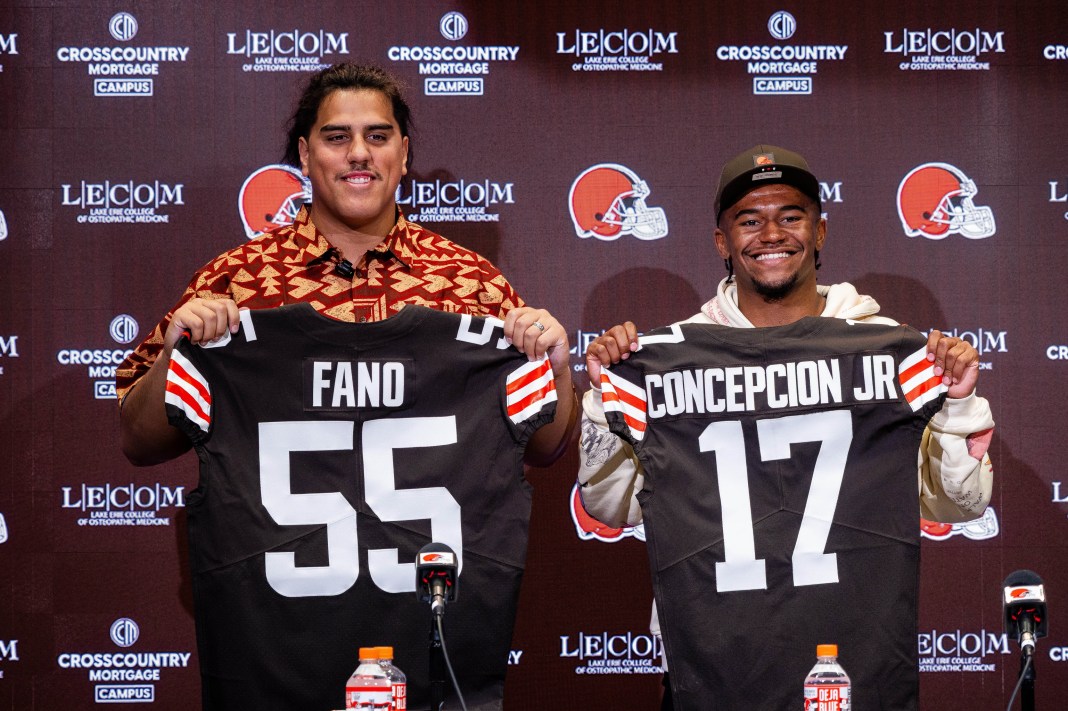
My criticism of Cleveland general manager Andrew Berry has been harsh in the past, but he has put together back-to-back impressive drafts. The Browns’ win total is 6.5, according to DraftKings, mostly because their quarterback situation is a circus until proven otherwise. Cleveland filled needs on the offensive line in the first round with Utah tackle Spencer Fano and in the third round with Florida tackle Austin Barber. Wide receivers were needed too, and the Browns grabbed Texas A&M’s KC Concepcion in the first and Washington’s Denzel Boston in the second. Toledo safety Emmanuel McNeil-Warren was another nice Berry pick in the second round. Will draft success show up in the win column? Let’s not get carried away.
New York Jets
Aaron Glenn did a horrible job as Jets coach during a 3-14 debut season. Glenn doubled down with a ridiculous statement in March when saying new quarterback Geno Smith, who was a disaster with the Raiders, will “lead us to the promised land.” New York general manager Darren Mougey, hired in January 2025, is off to a better start than Glenn. Mougey did the right thing by taking Texas Tech edge rusher David Bailey No. 2 overall and then snagging Oregon tight end Kenyon Sadiq at No. 16. Bailey totaled 14.5 sacks last season, tied for the most in the nation, and no Jets player had more than eight. Mougey traded up to No. 30 to get Indiana receiver Omar Cooper Jr. before picking another Hoosiers star, cornerback D’Angelo Ponds, in the second round. All four picks earn high marks, and I’m a huge fan of Cooper and Ponds.
It’s important to note the Browns and Jets are in similar situations because both teams need to find a franchise quarterback and didn’t get him in this draft. However, one more bad season could be a good thing for the future as next year’s class will be loaded with high-end quarterback prospects such as Arch Manning (Texas), CJ Carr (Notre Dame), Julian Sayin (Ohio State), Dante Moore (Oregon) and a few more.
Las Vegas Raiders
Las Vegas was lucky that Indiana quarterback Fernando Mendoza fell into their lap with the No. 1 overall pick, so second-year general manager John Spytek deserves little credit for that. Spytek’s first draft performance was dubious, but this one was much better. Mendoza will eventually be great, yet he won’t start early in the season unless veteran Kirk Cousins gets injured or can’t win a game in the first month. The Raiders had 10 picks and used them well, getting safety Treydan Stukes (Arizona) in the second round, edge rusher Keyron Crawford (Auburn) and center Trey Zuhn (Texas A&M) in the third, and cornerback Jermod McCoy (Tennessee) and running back Mike Washington (Arkansas) in the fourth. McCoy was a projected first-rounder who slipped because of injury concerns, so he could be a steal. I’ve seen too many pitiful Raiders’ drafts to proclaim they crushed this one, plus they needed a receiver and didn’t go that route until the sixth round. How much will these rookies help right away? The Raiders’ win total is only 5.5 and they are still the worst team in the AFC West.
Baltimore Ravens
John Harbaugh is gone, replaced by new coach Jesse Minter, but Baltimore continued to master the draft. First-round guard Olaivavega Ioane (Penn State) should start immediately on the offensive line and second-round edge rusher Zion Young (Missouri) also will help right away. The Ravens grabbed two of my favorite wide receivers, USC’s Ja’Kobi Lane and Indiana’s Elijah Sarratt, in the third and fourth rounds, respectively.
It’s worth noting that Harbaugh and the Giants emerged with a highly-ranked draft class, but they likely will regret passing on Downs twice in the top 10 and allowing Dallas to add a major impact player to its defense.