


How To Use Prediction Markets
Every bettor knows the feeling. You grabbed a futures ticket in August and the team comes out of the gate on fire. Your ticket is stuck to the refrigerator with a magnet or clogging up space in your “open bets” tab. Unfortunately, you have to sit and watch while the books move the number or until the event finally settles.
Prediction markets change that.
On federally regulated exchanges like Kalshi, you are not betting against the house like many sports bettors have for years. You are buying and selling those event contracts against other interested parties. Every contract pays $1 if you are right. They trade in cents that map to the probability of that contract paying off. A contract at 55 cents implies the market thinks it has a 55% chance of happening – or, in this case, to pay out. If that hot start moves the market to a 75% chance, you now have the ability to capture that move without having to take a massive haircut before selling it back to the book (which commonly manifests as the “cash out” option). The contract is now worth what someone is willing to pay for it, without being forced to resell it to the original book at a fraction of its current value.
In simpler terms, you can buy and sell whenever you want. And you aren’t limited by stock market “open trading” hours – if you want to sell your YES shares on “Rockets to win the title” for 32¢ at 4 a.m. ET… you can.
Prediction Markets are no longer a fringe offshore product. Kalshi, fueled by the World Cup, cleared $30 billion in June of 2026 alone. This doesn’t include the expected spike for the upcoming NFL season as markets expand and are available on brokerage apps like Robinhood and traditional fantasy football apps like Underdog. Even Polymarket, who were once relegated to offshore only, have come back into the fold under CFTC oversight recently. The market has matured, the offering menu has expanded and this guide explains how you can take advantage of that.
Event Contracts You Won’t Find on Any Betting Menu
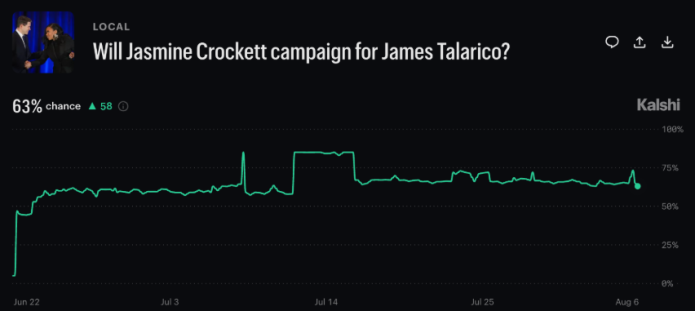
Sportsbooks hang lines and futures on games. Exchanges hang markets on anything with a verifiable outcome. Sports make up the majority of that market volume, but prediction market exchanges offer event contracts on elections, weather, economics, entertainment and cryptocurrencies too. For instance:
This all matters to bettors for two reasons.
The first is that these markets do not correlate directly with your sports betting action. You can certainly use the exchanges to hedge futures bets, but now you can also diversify your money outside of the sporting world.
The second and more important reason is that you now have a way to monetize your expertise in those other areas. Edges live where your knowledge base is greater than the public. Knowing something before the market realizes it has always been the best path to long term profitability. With a menu as vast as these prediction market exchanges have, everyone now has an edge somewhere. Your hobby, day job, or some random obsession might be your key to unlocking value that others do not yet see exists.
Live Betting on an Exchange is Just Trading
Live betting at a sportsbook means taking whatever number the book’s algorithm posts — minus the vig. Live betting on an exchange is more akin to the trading done at every financial firm around the globe. Books are like employing the buy and hold strategy in a financial market. Prediction markets allow you to be more like a trader. You get more flexibility to name your entry point, name your price, and name when and for how much you exit the position.
Every good bettor has passed on a play when the math stopped working in their favor. They would have bet if the odds were -105, but at -125 they no longer see it as a good value. Prediction markets allow you to never have to take a bad number again.
If a bettor would only take something at -105 or better, they can now offer to cover bets from anyone willing to grab the other side at that price. This manifests itself as a “limit” buy on markets, where you can say “80 cents” for NO and if someone matches at “20 cents” for YES… away we go. In other words, if someone chooses to fill, they get matched. If no one is willing, then it is the same position you were in at sportsbooks, with no play. Every number will not fill on a prediction market. You do not even get the chance to bet that number on a book, so anything that does fill on an exchange is better than your alternative.
Exchanges also offer more exit liquidity than a sportsbook will. If a book has balanced action on both sides, you are never going to see anywhere near the current value of your bet as a cashout. Nor are you guaranteed a chance to even try to cash it before the end. With exchanges, neither of those things are a problem.
Not only do you have the ability to choose when you want to sell, you can also set the price you would be willing to sell and the duration of how long that offer stays in the market. Many bettors stopped making pre-flop bets on games with books for this very reason. With exchanges, you can grab an underdog that is mispriced and actually cash out for a profit if they score the first touchdown rather than hope they hold on or invest more money to grab a middle.
Using Wager-Tracking Data to Read the Market
An entire industry was built around seeing line movements in real time on books. Line moves, bet percentages, and wager size are trade secrets books hold on to tightly. Exchanges are fully transparent. They do not need someone to build a business around it, because the bid/ask is the product. Open interest, total volume, and price history of every contract are listed and finally allow a bettor to see that price action happening in real time.
Look at this graph below. On the bottom left you’ll see real-time total volume ($69,826). The graphed lines represent price history, and even that red indicator next to the Ohio State number tells you recent movement:
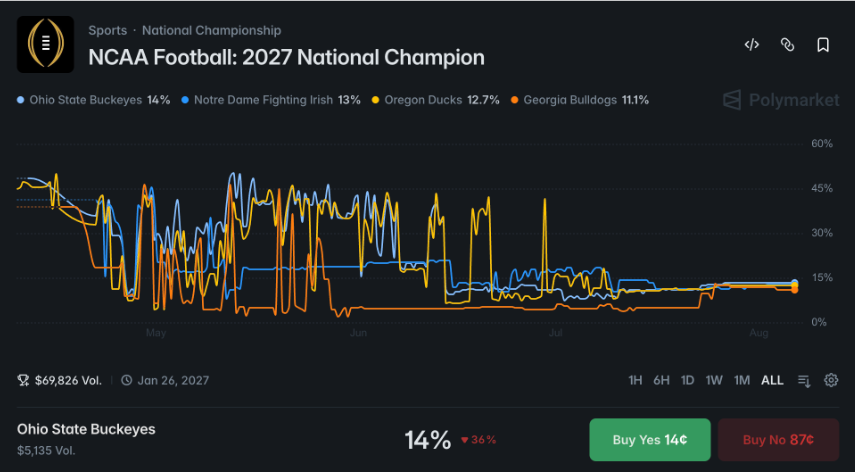
How does this help a bettor? This is where financial market experience may trump betting experience for someone new to prediction market exchanges. One thing traders track very closely is volume. If a price jumps or drops suddenly in a thin market (ie – not a lot of money in there yet), that means less than if it happens in a market with heavy volume. If it happens in a heavy volume market, that means the price movement is likely based on some new information that is just getting baked in.
Information moves fast, so make sure you know why it moved before you put your money on either side.
Another skill bettors becoming traders need to learn is how to read open interest. Here’s a quick primer on it from investopedia. There’s no real “simple” way to explain it, but I’m going to try here. In financial markets, bids can stack up at certain levels. The same is true of prediction markets. If open interest is high, that means people are willing to get in at that number and expect a profit when they do. Robust open interest means you have a larger floor – and that could mean it’s a less risky entry point. Rising or falling open interest could point to that floor strengthening or weakening. Sportsbooks do not give you this information. Some may, but it’s a delayed quote at best and inaccurately painted picture at worst.
Open interest, in possibly easier terms, is basically how many people are waiting for a certain price to buy or sell. If the market is 55¢ to buy YES on “Will the Chargers win the AFC Championship?” but 500 people all want $10 on 53¢ and are waiting for the price to fall, that’s the open interest.
The read on a specific market does not change because of open interest, but at what price and what size you are willing to enter and exit markets definitely should.
Building a Futures Portfolio
Prices in prediction markets are probabilities. Building a futures portfolio is not just stacking up tickets, it is now managing sizing, entry and exit prices. A bettor may have $100 to put into an NFL Super Bowl winner market in August. That bettor at a book would likely grab a few longshots, mix them with a few shorter priced teams and size them so if any of those hit, he makes a profit. That stack of tickets gets put in a drawer or left on his open bets board. The book may offer cashouts along the way, but they are always below market rate with massive vig.
A predictions market exchange, however, offers more flexibility along the way. A bettor could sell some of those longshots that are unlikely to win it all if they go on a run and bank a few wins. A 3 cent market move to 6-7 cents could double the initial investment and now allow him to trade that out for more shares of a 15-25 cent favorite that has a higher chance to cash. That 25 cent favorite may lose a game here or there and drop to 15 cents mid-season and allow an entry and more upside. How do you know how much you should put on any team? If you want the math on optimal sizing for each team, use a Kelly calculator, like this one here at VSiN. Remember, five bets on the same team is a conviction play, not a portfolio.
Arbitrage: Risk-free Upside
Two markets may price the same event differently. Arbitrage is how you get paid for noticing. If one exchange has YES priced at 45 cents and another has NO priced at 49 cents, that is your opportunity. You buy both markets for a total spend of 94 cents (45+49). One of them will pay out $1 per contract. That’s a 6 cent per contract guaranteed win with zero risk involved.
This also works with books vs. prediction markets. You can convert American Odds to prediction market prices by using a probability converter, like this one at PredictionMarketsPicks.com. If a book has odds of -150, that equates to 60% or a 60¢ market price on an exchange. Once converted, you can use the same math to figure out if you can take both sides and guarantee a risk-free return. If you can get NO on the exchange at 39 cents or lower and take the -150 on the book, you created an arbitrage situation for yourself with simple math and line shopping.
It looks great on paper, but let me caution you that some pitfalls do exist. The arbitrage never lasts long, as sophisticated players search for these and will pounce on opportunities when they exist. You also have to make sure you can fill at that price for the volume you want. If only a small amount exists on one side or the other in a market, that caps the amount you can arbitrage. The goal is to win the same on both sides no matter which outcome occurs, so the ceiling bet has to equal the smaller size of the offer book on either side.
Finally, make sure you read the rules. The market has to settle on the same underlying facts. With sporting events this is easy, but some event contracts may be on the same underlying asset, but use two different measures for the settle price. If one closes at 2 PM and the other at 4 PM, you have a two hour window where price could swing and you end up with nothing.
Odds Converter: The Skill That Unlocks it All
Most experienced bettors already have the understanding of markets, even if they do not realize they do. The one skill that unlocks that knowledge is the ability to convert American odds into probabilities. Learn to speak both languages and you can line shop in your head by just looking at the board. Becoming a bi-lingual bettor (American odds and market probabilities) can easily allow you to find arbitrage opportunities when they exist.
The first step in learning this skill is to memorize some of the anchor numbers. “Even money” is +100 American odds and equates to a 50% probability and price on an exchange. Other key numbers are the standard -110 (52.5%), -150 (60%) and +200 (33.3%). The VSiN betting calculator page or The 7 Oracles converter both have the math if you want to learn the equations to do this by hand. It makes sense for serious bettors to learn this math, but at the very least make sure you bookmark that calculator page so you can always come back to it.
Buying and Selling Positions: The Exit is the Edge
Strip away everything else mentioned here and the most important takeaway is this: A sportsbook wager is a commitment, an exchange position is an asset.
A book locks your money until settlement, with the only out a negative “cash out” one that undervalues what you hold. You cannot trim your position, so it’s either all in or all out if you do want to sell. Positions in a prediction market offer you more optionality. A team starts hot, you can sell off a piece to recoup your initial investment and free ride the rest at a zero cost basis. Your initial read was dead wrong? You can wait for a pop and try to maximize your exit. The downside is less, the flexibility is higher, and at the end of the day that means you have more options to take what the market is giving you while not being penalized as heavily for changing your read midstream.
The other thing that exchanges provide is an easier way to fade the public. If you think a contract is overpriced, you can take the other side of it. Rather than just pass because you see no value taking an inflated number, you can now profit by taking the other side of that number. This ability used to be reserved only for the market making book, but exchanges allow everyone to be a market maker and open up new ways to profit off a strong stance that did not exist for many bettors before.
The Bottom Line
Prediction markets reward sharp bettors for what they already do. Line Shopping, bankroll management, and sorting relevant data are how traders and sports bettors stay in the game. The difference is prediction markets offer you more tools to be profitable: Public tape, exits at fair value, and the ability to take either side of the market. Start small, convert prices to probabilities, learn how to enter trades, and treat your bankroll like a portfolio. Master those skills or translate the betting skills you already have; you should see your profits rise along with the popularity of prediction market exchanges.