


What is a Prediction Market?
Let’s start with the simplest, if not necessarily perfect, definition. If you’ve ever bought a stock, you’ll understand what a prediction market is. Say you buy Ford at $15. Tomorrow it goes up to $18. The next day it’s down to $14. You can buy and sell at will – as long as someone is on the other side.
Prediction markets take that and make it about nearly anything you can imagine: the Cowboys’ chances to make the playoffs, The Odyssey’s Tomatometer score, or even certain words Sarah Jessica Parker may say at a college commencement ceremony.
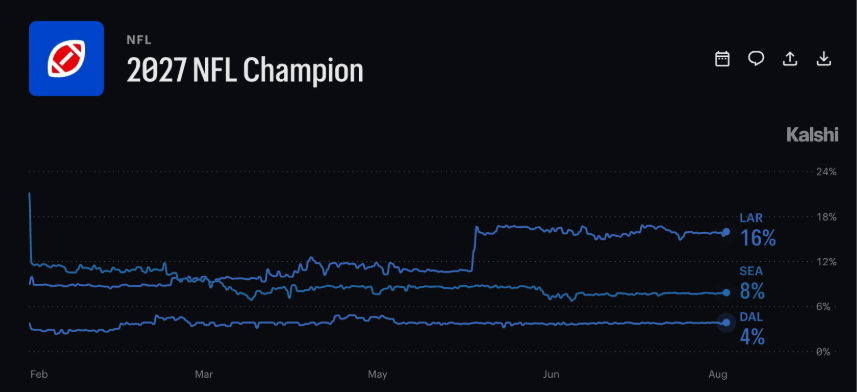
Let’s take a look at the Cowboys’ chances to win the Super Bowl (which, because of rights issues, you’ll see listed as something very straightforward, like “NFL Champion”). We’ll use the Kalshi page for this example.
This graph shows the chances of Dallas, the Rams, and the Seahawks (NOTE: all the NFL teams are available to buy for this market, we just wanted to make the graph easy to read with three teams):
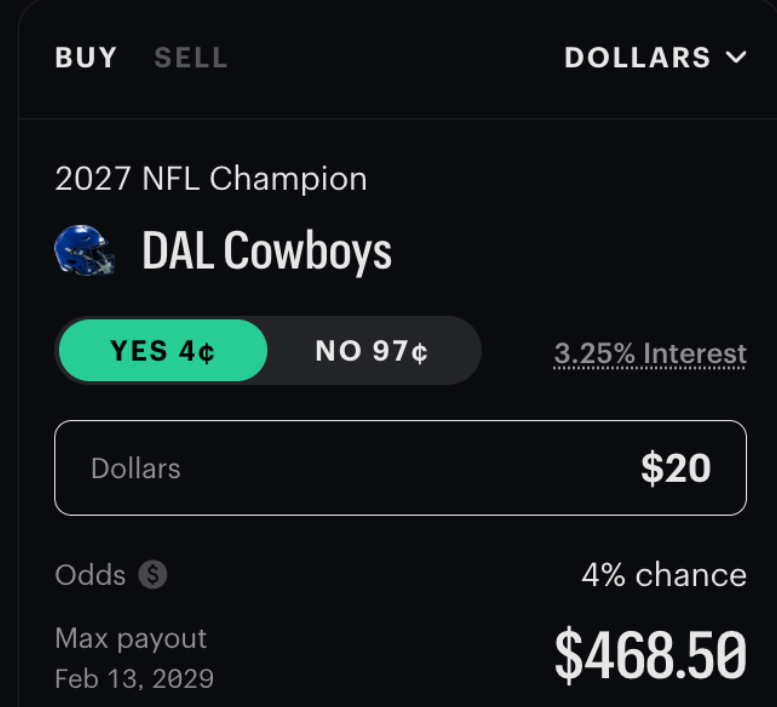
You can “buy” Dallas, with a 4% chance to win the Super Bowl, for 4¢ at the moment of this column:
And this is where a prediction market will break off from a sportsbook.
You are now buying and selling “shares” of the Cowboys from and to other people. There is no house that sets and moves odds; the market does it all. So if the Cowboys come out and win their first four games, that 4% chance is going to run up to maybe 20% or 30%. Your shares will rise accordingly. So you’re going to be stuck with a conundrum here – sell your shares while they’re hot and the public wants to buy in… or have faith in your Cowboys to win it all – and collect your $468.50.
This isn’t exactly the same as the “cash out” option offered by sportsbooks because those aren’t always available and they’re an enticement by the house for you to take a certain set of odds they set. Selling your “yes” position now depends on a market set by fellow traders. If the Cowboys go 2-2 and it hovers at 4¢? You can still sell that and put the money (minus the fees) into your portfolio for a new purchase anywhere else on the site.
And you will see prediction markets have nearly any subject or timeline you can think of. If you want to buy “yes” on the 49ers to win at the start of the second half in a game where they’re down 10 and at 22% odds? Go ahead. They score a quick touchdown and get a quick turnover and you may be looking at a 65¢ position that you can sell – or ride. But in three minutes your fortunes have changed. And if they get clobbered and lose? That “stock” is now worthless. On to the next!
LEGALITY
When sports betting was opened up in 2018, after the Supreme Court declared PASPA (the Professional and Amateur Sports Protection Act) unconstitutional, states had to decide whether they would legalize sports gambling (and then how to regulate and tax it, etc.). But prediction markets have technically been legal under the rules established and overseen by the CFTC (The United States Commodity Futures Trading Commission). So they can operate across the country as derivative markets – and not sportsbooks. The main distinction is that markets are peer-to-peer and prices are set through that process; there is no “house.”
It has become a point of contention across the country, as states have tried to ban prediction markets and the CFTC and some higher courts have sued, overturned, or blocked the ban because of the federal laws allowing them. Pro-market advocates point to the CFTC rules; anti-market proponents simply say “this is betting” and the markets are getting around legal issues, tax issues, and a host of other concerns.
For now, though, this all means that residents of states like California, Florida, and Texas – which have not yet legalized sports betting – are allowed to use the sites to buy and sell positions on things like Dolphins win totals, or if the Warriors will win tonight, or even what words Donald Trump may say in his next speech.
Nevada, however, has successfully stopped markets from operating within the state. But Minnesota’s ban was overruled in court as it was about to take effect.
It is a maddeningly blurry line that has overwhelmingly gone in favor of the pro-markets side. But it has created a world where Pat McAfee struck a deal with DraftKings and created a game show that then had its own prediction market. Residents of California, Texas, and Florida could buy positions on it, no matter how much it felt like betting.
TERMINOLOGY
Let’s dive into some common terms you may hear as you test the waters of the prediction markets:
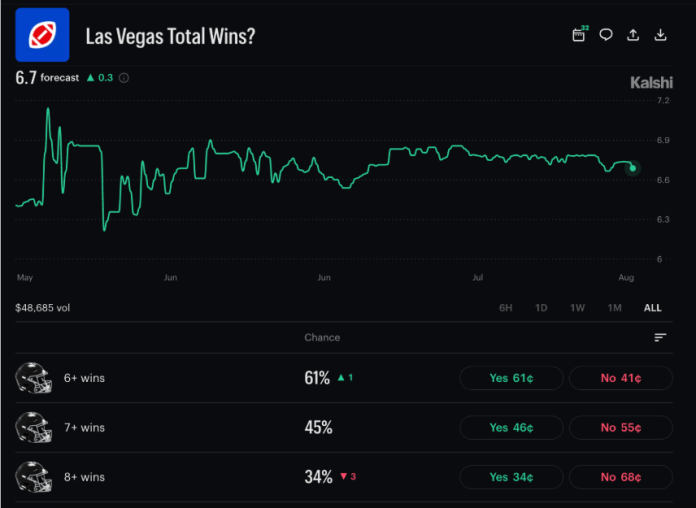
THE STRIKE: Maybe the most important “non-obvious” term to know is “strike.” It is, essentially, what you can buy. The Strike is a term borrowed from options markets. For prediction markets, a good example is each number in an NFL win total. For the Las Vegas Raiders, the market is 61 yes/41 no at the “6+ wins” strike:
MARKET: A market can be made on any question as long as there is a definitive two-sided answer (most commonly “YES” and “NO”). Even a win total ladder or event winner can be broken down by strike into a single yes/no question – such as “will the Chiefs win over 10 games or will they win the Super Bowl?”
LIQUIDITY: How easy it would be to buy or sell a given contract. The more money in any given market, the easier it is to enter and exit. The more buyers and sellers a market has, the smaller the range becomes between the bid and ask price. In smaller pools that “lack liquidity,” you may have trouble finding someone to take the other side of your trade, trouble selling out of your position and trouble getting someone to take it at market value. So a market for the Super Bowl winner will have $30 million of volume and prices will be accurate to percentages – and easy to buy and sell at your leisure. But a market on something like the lowest temperature in Phoenix today will have about $8,000 and the prices won’t be great, with the ability to buy and sell a little harder and slower.
LIMIT ORDER: A limit order is an offer to buy a contract only if its priced execution reaches your limit or better. A limit order can be on the ceiling of a buy or the floor of a sale. In plain english a limit order is like saying “I will only buy something at this price or lower or will only sell it at this price or higher.” If you place a limit order and nobody bites, it doesn’t happen. Think of this like a price haggle. Maybe you shake hands, maybe you both walk away.
RESOLUTION SOURCE: The resolution source is the definitive authority answering the market question. The single source of truth that defines whether a market closes yes or no. Maybe it’s the National Weather Service for a temperature market, or a certain stock exchange for the price of a stock, or a certain stat provider for a sports market.
ARBITRAGE: The act of taking advantage of different prices on the same underlying strike. The easiest example is this: one market offers YES at 47 cents and a different platform offers NO at 49 cents on the same strike with the same resolution source. You buy both in this scenario, as 47 + 49 = 96; it should equal 100, so whichever side wins, you make money overall. There is a more detailed definition here. Arbitrage never lasts long, because it’s guaranteed profit and smart traders or bots eat that up right away.
HEDGE: Hedging is insurance in case your desired outcome does not happen. The easiest example is betting against your long held ticket in a deciding game. If you had the Patriots to be Super Bowl champion of the 2025-26 season, you could have hedged that potential big money futures ticket by taking the Seahawks in the Super Bowl so you make money no matter the outcome, although you give up some of the potential upside. A twist in prediction markets is real-life hedging. A bar in Manhattan famously “hedged” a Knicks win against their P&L (profit & loss) during the 2026 Playoffs. Kalshi has an entire section dedicated to small business hedging, with the most famous example being an ice cream shop “hedging” against the weather.
MARKET ORDER: A market order is meant to be executed immediately at whatever the best price available is in the market. In liquid markets, this is usually very close to the listed price. In illiquid markets, you can end up with an execution price that is noticeably higher or lower than the quoted price if you use a market order. Market orders are the default contract for prediction markets, but they should not be for savvy traders.
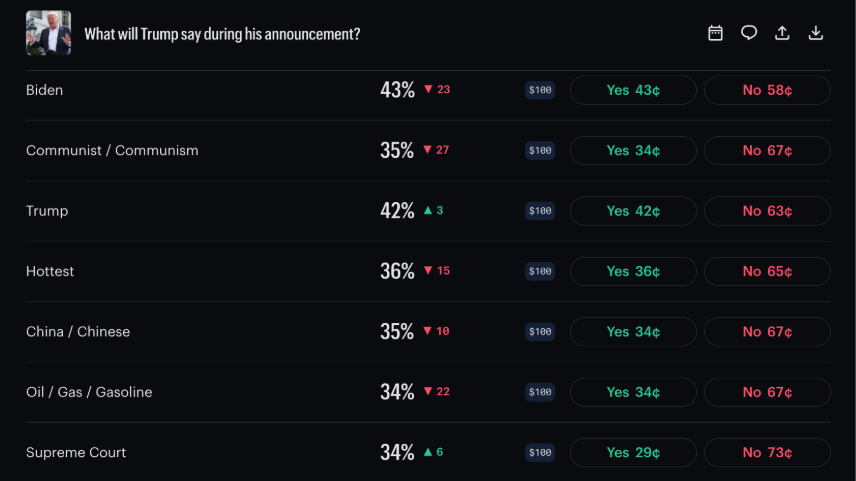
MENTIONS: A growing – and fun – set of markets are “mentions” markets, usually presented as “what will _____ say at ______?” It’s a series of words of terms that will be mentioned on everything from presidential press conferences (“Dumbocrat”) to company earnings calls (“GLP-1”). You can buy and sell strikes on the terms and watch along live. When your term is said out loud… you win.
PERPS: Perp is short for “perpetual contracts.” These are futures that have no expiration date. Perps allow traders to make leverage bets on the price action of the underlying contract. This allows for greater upside, but also the prospect of margin calls and forced liquidation if the market moves in the opposite direction.
This is a great explainer on Perps: https://www.youtube.com/watch?v=yZNQqXyMFMo
PEEPS: Delicious sugar-coated marshmallow treats. There is no current market related to Peeps… but give it some time.
POPULARITY
It is going to be nearly impossible to accurately state the popularity of prediction markets because they are growing so fast. Here’s a look at trading volume, via TokenTerminal, as of July 2026. It’s exploding:
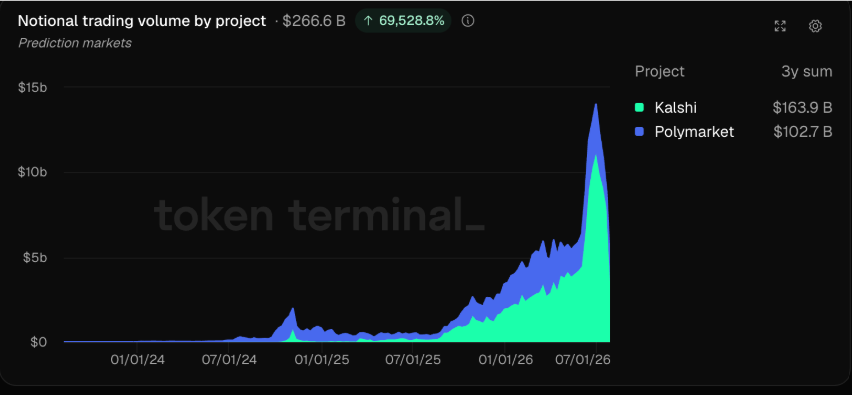
In a May 2026 column, the Pew Research Center reported Kalshi + Polymarket volume at $26 billion in April 2026. Legal US sportsbooks, in contrast, averaged about $14 billion per month in 2025. And the World Cup reportedly pushed July 2026 volume past $50 billion for Kalshi and Polymarket combined – which doesn’t even count assorted other markets at places like Novig, ProphetX, Fanatics, DraftKings, FanDuel, CME, etc.
Is it safe to say markets are bigger than sportsbooks? In a sense, yes. But sportsbooks make more money (they are the house; markets usually just take fees off transactions…for the most part) and aren’t facing the current legal battles that prediction markets are currently facing.
One of the advantages markets have over sportsbooks is the availability. States like Texas and California don’t allow DraftKings to operate there as a sportsbook – but the company can operate legally as a prediction market, protected by the federal CFTC as opposed to the states’ laws on sportsbooks. As long as courts keep ruling in favor of the CFTC and the federal rights of markets (and this has been the trend, especially with heavy Republican/Trump influence federally), they will continue to grow and likely explode in popularity during football season and into the Super Bowl.
EVENT PRICING
Bringing this back to the stock market parallel, prediction markets price their strikes between 1¢ and 99¢. You can buy and sell through the launch of the event to the resolution (ie – until the thing happens, whether it be a title game won, a word said in a speech, etc.). There’s an excellent in-depth primer on event pricing by former bond trader Benny Ricciardi if you want to learn more.
One of the advantages prediction markets have over sportsbooks is the simplicity of the “percent chance” structure. We all grew up hearing that there’s a 75% chance of rain today. Now it’s applied to events. Having percentages (13% chance YES on “Will the Dolphins kick two field goals?”) as opposed to sportsbook odds (+669 on Dolphins 2+ field goals) is an easier, more relatable format that will likely attract more regular people.
If you want to play around with percentages vs. odds, The 7 Oracles has a free converter tool that’s easy to use, and so does VSiN.
BUY/SELL (yes/no)
This is the most straightforward feature of prediction markets, and what makes it so appealing. WIll something happen? Yes. Will something happen? No. You pick your side.
Buying and selling strikes can be done throughout the event’s term – you can buy NO for 10¢ on “Will the 49ers win the conference?” and if they start 2-6, you can sell it at 45¢ (or whatever the market has it priced at then). If they rattle off a seven-game win streak, you can always buy YES for 65¢ if you so choose. Buying and selling whenever you want is what makes these markets fun.
FEE STRUCTURE(S)
The fee structure on prediction markets is, to put it simply, “all over the place.” For most markets, fees will change depending on what and how much you buy. It may also depend on if you’re a buyer or seller.
Your best action is to check the “fees” page – and make sure you have about five minutes to interpret the charts and formulae. Otherwise, just put in the order and let the site do the math for you – these aren’t exorbitant numbers, but there are fees you should be aware of.
Some examples are below: