


Prediction Markets vs. Sportsbooks
Look, you’re reading this on VSiN – you’re probably a bettor, or someone searching for info on it. But give us a minute here to guide you through the waters of prediction markets – they’re nuanced and, for lack of a better term, fun.
Let’s begin with…
Price Transparency
With sportsbooks, you’re going to see odds in several different formats: the American-style -110, the Canadian decimals, the European “3/1” – but prediction markets are built on percentages and “cents.” In its simplest explanation, if something has a 57% chance of happening, it will cost you 57 cents on a prediction market (this sometimes doesn’t line up perfectly because of market forces, but that’s detailed in a different column!) And it operates like a stock market – there is no “house,” technically. You’re buying and selling with other traders – whether it’s a person or a syndicate/fund; someone is on the other end.
A sportsbook’s house can change lines as news comes and goes, but with prediction markets you’ll see a literal line – on a graph – move as that information comes in and prices change. The market moves it, not an algorithm or oddsmaker. If you have a 65¢ “YES” on the Lakers to win the game before tip-off, you’ll be on a roller coaster as they fall behind, surge ahead, and give up runs. That price will go up and down until the game is over, where it settles at 0 or $1. In between you can sell, buy, hold – whatever your heart desires – but you’ll see that line move as the trading masses react in real time.
Yes, the book may offer you a cash-out option, but that’s up to them and on their terms. The market is, so to speak, “always open.”
Know the Buy/Sell Format
I pulled this screenshot from a Kalshi message board:

Let’s just forget about -135s and +140s for a moment. The user here likely is a novice who came from the betting world (and you may be too!), where putting $10 on a yes or no proposition (like the Super Bowl coin flip, for instance) might have led him to believe – once you’ve won – that you’d essentially double your money on an “EVEN” win.
That is not the case here. Saying “YES” on the new Spider-Man being over a 74 on Rotten Tomatoes likely had a 97-99%ish probability. So putting $10 on that would pay back almost nothing (or 38 cents in this case). If you wanted to double your money on a market, you would have gone with YES on “Above 93” or something along those lines, as the Tomatometer score was hovering around 92-93 at the time.
Very important note here, whether you’re on a sportsbook or the markets: sites will compute and show your winnings before you execute the trade or bet; and maybe this user just didn’t check, but YES/NO is not a 50/50 proposition, even if it might appear like that to a new user.
Always check the percentages. Think of it like this: if there’s a 99% chance of rain today and there are dark clouds everywhere, you buying “YES” has almost no risk; the payout if it rains will be small. But you buying YES if there’s a 47% chance of rain and it’s currently sunny? There’s your chance to double your money.
A Stroll Through A Non-Sports Market
Let’s walk through a quick scenario by taking a look at the 2028 Democratic nominee market. Here’s what it looks like on Kalshi, one of the most popular prediction markets platforms:
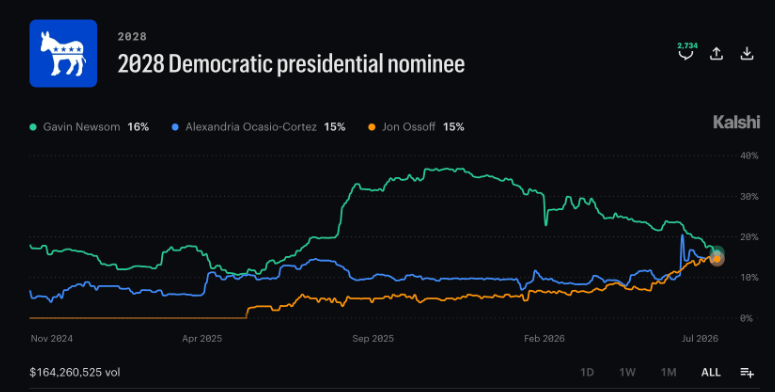
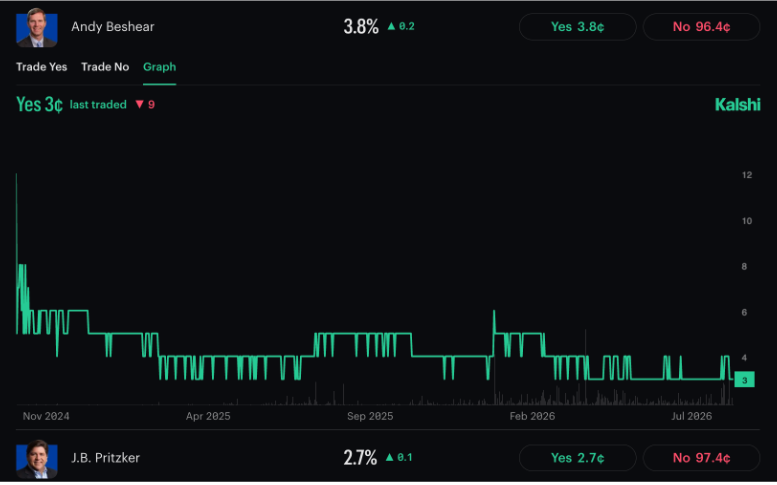
Say you like Andy Beshear and have a good feeling about his chances to get the nomination. In July 2026, you could buy a “yes” on him for 3.8¢ based on the market thinking he has a 4-ish% chance of winning the nomination.
$20 will get you $492.89 if he wins the nomination (more on the fees a little lower). You now own “stock” in Beshear winning the nomination:
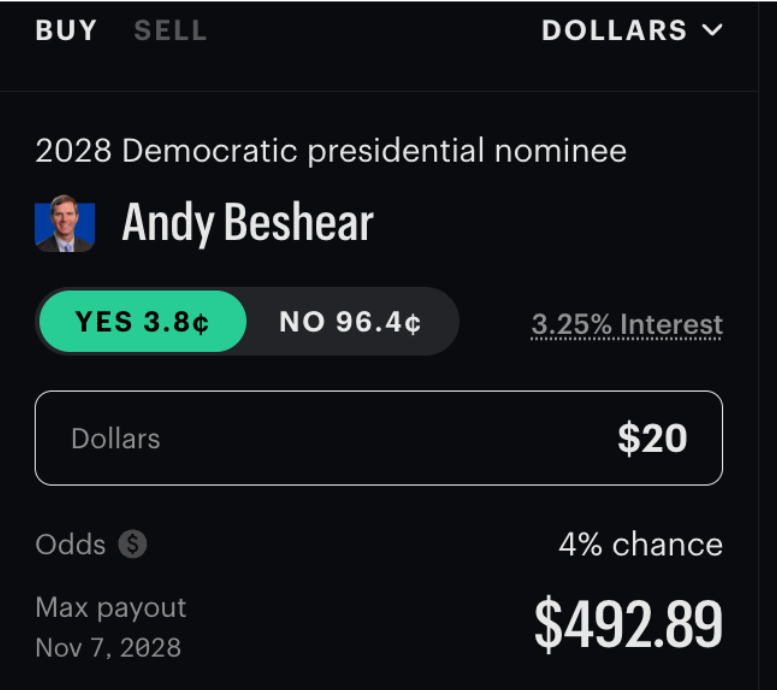
Now let’s say Beshear has a couple viral moments, two incredible debate performances, and outlets start declaring him the favorite. His “yes” price climbs to, say, 55¢ a share. You can sell then. Unlike the stock market, it doesn’t have to be between “market hours” – it’s always market hours, so you can make a trade at 4 a.m. if you’d like. You could have also sold the day after you bought your position for, probably, 3.8¢. Or you can wait and sell tomorrow. Or the next day. And if he ultimately wins and you held on to the stock? The site will pay you out that $492.89.
Another important distinction
So far we have two examples – the Lakers game and the Democratic nomination. While most sportsbooks are beholden to just sports (and the occasional Academy Award-type stuff that is only available in some areas), prediction markets offer the ability to buy and sell on almost anything – from Rotten Tomatoes scores to the next White House Press Secretary to fine art sale prices. It opens up the door to something The 7 Oracles co-founder Benny Ricciardi said in another piece here: Your hobby, day job, or some random obsession might be your key to unlocking value that others do not yet see exists.
Sports are great and fun, but prediction markets offer you the opportunity to punch almost anything you can think of into the search field and see what pops up.
Fee vs. Vig
This one is fairly straightforward. The “vig” in sports betting is defined as “the commission that a bookmaker or sportsbook takes on bets.” (more on that here in the VSIN glossary). It’s already baked into any bet you make, so something that SHOULD be a -135 will end up being something like -145.
Prediction market fees, like the vig, are going to be baked into the cost, generally. However, if you sell your position before an event has resolved, you’ll pay fees then, too. At its resolution, if you win, the sites won’t charge you fees. Because prediction markets have an entirely different regulatory body and exist under different rules than sportsbooks, the fees are going to vary between sites, bets, bet sizes, and more. However, buying and selling essentially will feel the same to you, because with the fees being baked in, the site will just calculate it for you.
Building user trust in prediction markets – Are they legal?
Since prediction markets are under the jurisdiction of the CFTC, and run in the same circles as stock exchanges and even banks, “trust” hasn’t been a huge issue.
Most trepidation related to the markets centers around their legality – are they betting? Are they true markets? Does the answer lie somewhere in between?
As with almost anything, check reviews on the apps and sites you plan to use, but generally the larger exchanges – Kalshi, Polymarket, Robin Hood, DraftKings, FanDuel, etc – are going to be legitimate, legal, and able to pay you out when you request it.
Now, some of their choices in what constitutes a win may cause occasional controversy, but as these exchanges mature, they learn and get better at using very pointed and detailed language to describe how a market will resolve. ALWAYS READ THE FINE PRINT (we wrote about that when the Maxx Crosby free agency market hit some road bumps)!
Parlays
The language the markets use for parlays is “combos.” And they are defined as “multi-leg financial event contracts.”
Here’s how Polymarket explains it:
The payout on a Combo is calculated by multiplying the implied probabilities of each leg together. The fewer the chances of all legs hitting, the higher your potential payout.
If any leg of your Combo resolves incorrectly, the entire Combo is lost.
You can sell your combo on the open market before it resolves, the same way a sportsbook occasionally offers you the “cash out” option.
Hedging
We’ll get into hedging a little more below, but because markets offer contracts beyond sports, it brings into play a mind-bending idea of hedging against real life.
To keep it simple, say you’re a die-hard Democrat. You want nothing more than for Democrats to win elections because their policies will benefit you. There is a market for your local House of Representatives seat. You can buy the Republican candidate and “hedge” against a Democrat winning. This way, if the Republican wins, you still “win.” If the Democrat wins, you lose the market money, but your hypothetical small business will benefit from the policy and you technically also have won.
Futures Portfolio/Positioning
Gamblers make bets. They hold those bets and hope they eventually cash those tickets. It is very much a buy and hold strategy. Cashing out early tends to come at a loss to present value.
Traders build prediction market portfolios. They actively manage. A good trader will add positions when price or circumstances warrant it. They may even hedge exposure to a certain outcome to lock in some profits or downside protection without selling. A trader that holds shares of a team to win the Super Bowl may hedge his exposure if that team makes the big game by buying shares of the other team winning. If he invests $100 in futures at 9 cents for Team X to win, he would be set to make $1000+ if they do. If team X is favored, he could make a wager on their opponent and guarantee a profit no matter who wins. He could make a small hedge to cover his initial investment or a big one to split the difference on the full winnings.
The same could be said of the Bitcoin markets. If a trader took a position at 12:01 on the price at 1 PM, they may see the move happen earlier in the hour. By the time it gets to 12:45, they could easily lock in some profits on a position now deep in the money by also grabbing the opposite side of the 15 minute market. That way if the market continues in their favor, they lock in the big gain on their hourly buy. If it moves slightly against them, the 15-minute market hedge pays off, so they can lock in a small profit. The best case scenario is when the upside and the downside have some area where both plays would cash. That is called a middle and is my favorite type of hedge. If the price goes over, you win, if it goes under, your hedge wins, and if it hits that sweet spot where it’s over the one number and under the other, you win both sides of the play and clean up.