


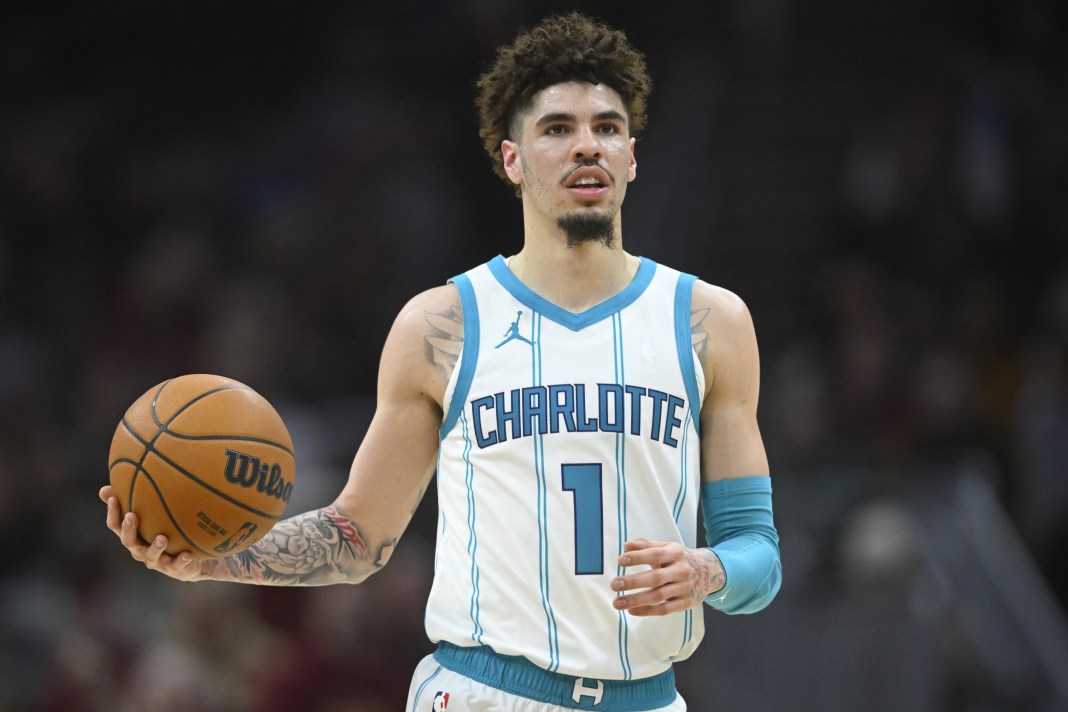
With the 2025-26 NBA Playoffs ending with yet another disappointing exit, the Minnesota Timberwolves have been looking to make a splash, and on Thursday, June 25, Tim Connelly delivered a tidal wave. The Wolves’ highly aggressive president of basketball operations agreed to a blockbuster deal with the Charlotte Hornets, bringing guard LaMelo Ball — and Josh Green — to Minnesota in exchange for big man Naz Reid, a 2033 unprotected first-round pick, three first-round pick swaps, and three second-round picks. Keep reading for a full breakdown of both sides of the deal and the betting implications that come with it.
The Hornets Side
Towards the very end of the second round of the 2026 NBA Draft, ESPN’s Shams Charania reported that Charlotte was aggressively fielding offers for Ball. That report felt like it came out of nowhere, but the trade is usually imminent once something that wild is put out there. Well, just about 12 hours later, the Hornets sent Ball to the Timberwolves, closing the book on his run as the face of the Charlotte franchise.
All of the reporting we have seen today suggests Ball was happy with the Hornets and he viewed Charlotte as his long-term home. Unfortunately for him, it’s clear the Hornets front office was desperate to move on. Charlotte sent Ball out for what looks like an underwhelming return, suggesting the team was eager to rip the bandaid off.
Ball is arguably coming off the best season of his career, as he averaged 20.1 points, 7.1 assists, 4.8 rebounds, and 1.2 steals per game. He also posted the highest Estimated Plus-Minus (+4.5) of his career, finished in the 97th percentile in Estimated Wins Added (10.6), and was available for 72 of the Hornets’ 82 games. That last one was a big one. But Charlotte has worked hard to overhaul the culture inside the building, and head coach Charles Lee and president of basketball operations Jeff Peterson seemingly felt that Ball didn’t mesh with the direction they’re looking to go. For as good as Ball is as an off-the-dribble shooter and a pick-and-roll playmaker, he’s still wildly inefficient and he doesn’t play defense. Also, even though he played 72 games in 2025-26, he has played fewer than 50 games in three of his five 82-game campaigns.
The Hornets also inked Coby White to a three-year, $74 million deal right after the trade, and his presence — along with the arrival of first-round draft pick Christian Anderson — shouldn’t be ignored here. Charlotte had a +13 net rating with White on the floor with Kon Knueppel last year, and that was higher than the +10.2 number that the rookie had with Ball — even if it was in a small sample size.
Outside of just moving on from Ball, the team also added a highly-talented big in Reid. Last year, Charlotte’s frontcourt was a major weakness, but Reid brings a serious floor-spacing element as a career 37.1% three-point shooter. He also has an extremely underrated bag, as he’s comfortable shaking opposing bigs and getting to the rim. With the Hornets having also drafted Hannes Steinbach in the 2026 NBA Draft, frontcourt versatility is suddenly a major strength with this team.
The picks are also massive for this organization. Charlotte is operating with a major surplus when looking at the team’s tradable first-rounders, meaning the Hornets can get involved the next time another star hits the trade market.
The Timberwolves Side
This side is easier to explain. While giving up valuable draft capital is always tough to swallow, Minnesota, a team in desperate need of extra playmaking and perimeter firepower, was able to get a unique talent in the building. This franchise has been putting too much on Edwards’ shoulders, and a lack of competent shotmaking and shot creation outside of him has hurt the Wolves in the postseason. Now, if teams double up on Edwards in the playoffs, Ball will absolutely torch them. Also, his ability to be a pick-and-roll initiator, and overall table-setter, will make everyone on the Minnesota roster better.
The Timberwolves could have attempted to make a similar move for Kyrie Irving, but Ball is a better gamble. As someone that was drafted right after Edwards in the 2020 NBA Draft, Ball fits Minnesota’s timeline better. If the Timberwolves can’t find a way to maximize this current window, they at least know they’ll have Ball, Edwards, Jaden McDaniels, and some of the other young guys to build with for the future.
Minnesota now has an intriguing lineup, as it seems like Ball, Edwards, Terrence Shannon Jr., McDaniels, and Rudy Gobert will be the starting five. The team also has Ayo Dosunmu as another option. This is now a rotation that will try to beat you with finesse, whereas the two-time Western Conference runners-up looked to beat you with force.
My only major questions with the offseason come down to timing. Did Minnesota know that moving Reid was a possibility when Julius Randle’s salary was dumped? And did the Timberwolves knows Ball was incoming when they gave Dosunmu a five-year contract? I just wonder whether the team is properly divvying up its resources. I also have a feeling that Minnesota isn’t done dealing. The Wolves can now use some additional frontcourt depth.
Betting Impact
While some numbers suggest Charlotte was a little better with White than Ball, the team’s short-term ceiling is much lower today. The Hornets have a good amount of talent on their roster, the rotation is more balanced than it was a year ago, and this should remain a well-coached team as long as Lee is on the sidelines. However, Charlotte seemingly lacks someone that can apply consistent rim pressure on opposing defenses. That said, the Hornets looks to be in worse shape heading into the 2026-27 season, whether that’s thinking about their overall record or their chances of winning the Eastern Conference. That’s why they went from 80-1 to 200-1 to win the title at DraftKings Sportsbook. But Charlotte is in a good position to improve the roster, so perhaps Peterson will make a massive deal that changes things — and maybe that happens before the offseason is over.
For Minnesota, the ceiling is higher and the floor is lower. The former is reflected with DraftKings having moved the Wolves from 30-1 to 22-1 to win the title. Having an on-ball creator like Ball next to Edwards makes this team much tougher to guard, but the defense will also slip significantly. Also, Ball’s inability to stay healthy looms large. Dosunmu and Edwards would look just fine in a backcourt together in the event of a Ball injury, but the frontcourt is no longer good enough with Randle and Reid gone.
I also mentioned this on Money Moves with Stormy Buonantony and Jonathan Von Tobel, but the Wolves might be a good Over team to start the season. After being a defensive-minded group for years, they’re suddenly leaning all the way into offense — with poor Gobert being tasked with doing all of the team’s dirty work.