



Model sits at 78-44-6 on the year. Let’s keep this rolling into the second half of the fight calendar.
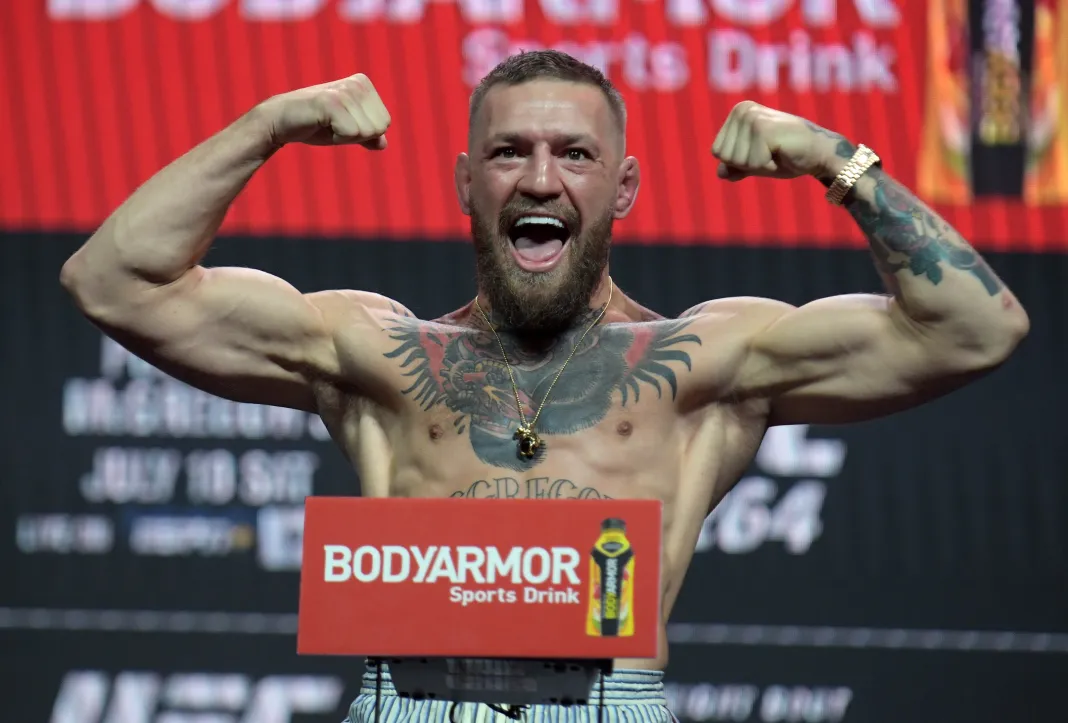
What better way to start the second half of the year than with the return of Conor McGregor?
Dave Ross and I broke down the full card on this week’s First Strike, catch the episode everywhere you listen to podcats and also on YouTube.
Let’s dig in.
Tracy Cortez vs Wang Cong
Tracy Cortez is a legitimate flyweight with two losses against top-tier opponents, a submission loss to Erin Blanchfield and a decision loss to Rose Namajunas. Those aren’t blemishes, those are legit record entries. She’s 1–2 in her last three but the level of competition explains the record.
Wang Cong is the question mark. On a three-fight win streak with her only professional loss coming in a submission against Gabriella Fernandes back in 2024, she’s bouncing back in style. But Saturday represents a significant jump in competition, and how she handles that jump is what this fight is really about.
The xR% gap is notable on paper. Cortez sits at 62%, a solid mark built against genuinely tough opponents. Cong checks in at an impressive 83%, though the competition caveat absolutely applies. We take that number seriously while acknowledging the resume it was built against.
Neither fighter has been a prolific finisher. Cong has one UFC knockout, Cortez has zero UFC finishes. Both have been submitted once. This fight has decision written all over it, which makes the round-winning metrics especially meaningful.
The striking profiles heavily favor Cong. She spends 78% of her time at distance, landing 6.22 significant strikes per minute with an outstanding +3.94 differential, absorbing only 2.28 per minute. That is a genuinely elite striking profile at any weight class. Cortez lands 3.79 per minute with a +0.73 differential, absorbing just above three per minute. The output gap is real, and Cong has scored three knockdowns in the UFC while Cortez has been dropped twice and has never sent anyone to the canvas herself.
Cortez’s likely path runs through the grappling. She holds a 68% control rate in clinch and ground exchanges, spending 35% of her time in a control position, with 16 takedowns at 44% accuracy and 2.93 attempts per five minutes. The question is whether she can get there against Cong’s 84% takedown defense, arguably the strongest defensive number in this matchup and potentially the strongest grappler she’s faced to date.
The model delivers a 72% win probability for Wang Cong with full confidence, solid Tier 1 Favorite designation. Her current odds sit at –110, which represents genuine value when measured against the model’s output.
Full transparency, the line was –120 when I got in, and money has since come in on Cortez pushing it down. I understand why people like Tracy. She’s tough, she’s experienced, and a grappler who controls the pace is always a threat. But we trust the model here.
Wang Cong goes on the slip at –120.
Nikita Krylov vs Robert Whittaker
The former interim middleweight champion takes one of the more fascinating gambles in recent memory, leaving a division where he was always a legitimate title contender to debut at light heavyweight against a finisher in Nikita Krylov.
Whittaker finished his middleweight run on a two-fight losing streak, a submission loss to Khamzat Chimaev and a decision defeat to Reinier de Ridder last July. Krylov enters on a two-fight split himself, most recently a TKO win over Modestas Bukauskas in January after back-to-back TKO losses of his own. Both men sit at 2–2 in their last four.
The standard caveat applies here. Whittaker’s stats represent his entire UFC career at middleweight. A weight class change introduces variables no dataset can account for.
Physically, Krylov is the bigger man, three inches taller at 6’3 and four inches of reach advantage at 77 inches. Those numbers matter at light heavyweight in ways they wouldn’t have at 185.
The xR% gives Whittaker the edge. 67% for Bobby Knuckles and 60% for Krylov, which reflects the level of competition Whittaker has consistently performed against at middleweight. Strength of schedule goes firmly to the former champ, and that’s worth acknowledging.
Whittaker is a striker first, spending 81% of his time at distance and landing 4.39 significant strikes per minute with a +1.03 differential. His knockdown numbers are impressive, 12 scored in the UFC that double Krylov’s six, but whether that power translates at a new weight class is the central unknown. He’s also absorbed more knockdowns than Krylov, and that chin question at a heavier weight is real.
Krylov spends just 38% of his time at distance, he wants to get inside and create pressure. He lands 4.36 per minute with a +1.77 differential, absorbing less than Whittaker in the process. His finishing record is extensive with five knockouts and five submissions in the UFC, and he stays dangerous in close quarters. His 59% control rate and 12 submission attempts speak to a fighter who uses the clinch and ground as genuine weapons, not just positioning.
Whittaker’s 82% takedown defense is one of the best numbers on the card this week, and that will limit how much Krylov can dictate the ground game. But size, reach, and the pressure game from Krylov in the clinch could be the tool that neutralizes the striking even without takedowns.
The model runs it through and lands on the underdog. Nikita Krylov receives a 66% win probability and a Live Dog designation. Live Dogs have been cold lately, but the category is still profitable on the year and we’re not throwing it out.
We got in at +160 over the weekend with the line dropping all the way to +105 today. The model sees a prediction, but the value has really been lost there.
King Green vs Terrance McKinney
Some fights don’t need a breakdown. They need a warning label. That warning reads “Chaos in a bottle”.
King Green is 39 years old, on a three-fight win streak, and just submitted Jeremy Stephens two months ago. He has seven wins and six losses by stoppage in his UFC career. He is a man who has always been comfortable in violent chaos.
Terrance McKinney has never seen a decision in his professional MMA career. Every single fight ends by finish. He’s only seen one third round in his entire career, and 11 of his 26 professional bouts have ended in the first sixty seconds. Five of those happened in the UFC. His UFC debut lasted seven seconds.
The model does score in favor of McKinney at 58% win probability, but also flags the play as too risky to bet straight given the variance McKinney brings to every single second he spends in the cage.
So we’re not betting sides. We’re betting chaos.
With four of McKinney’s last six bouts ending in the first minute — wins and losses included — and King Green’s track record of participating in exactly this kind of mayhem, the fight ending in the first sixty seconds at +400 is the play. This isn’t a model recommendation. This is a calculated acknowledgment that these two men are uniquely capable of making something insane happen before most of us finish adjusting the volume on our TVs. Win or lose, the bet will be gone in 60 seconds.
It’s a small bet. It’s a fun bet. Let it pay for a nice dinner at Chilis.
King Green vs McKinney: first minute prop at +400. For the chaos.
Benoit Saint-Denis vs Paddy Pimblett
Speaking of violence. The God of War keeps marching forward, and the model is firmly on his side.
Benoit Saint-Denis is on a four-fight finishing streak, most recently putting the work on Dan Hooker for a TKO in January. He has nine finishes in his MMA career and has seen exactly one decision in his entire professional career, his first UFC fight. If you’re fighting BSD, you need to be prepared to go to war, because that’s the only fight he knows how to have.
Paddy Pimblett enters on the back of a tough loss, five rounds dominated by Justin Gaethje in January, falling short in his interim title shot. Before that, he was riding a nine-fight win streak. The question this fight answers is whether Paddy’s level has caught up to the competition or whether he remains a step behind the true elite.
The xR% gives BSD the clearer edge. 73% for the Frenchman, 64% for Paddy. Strength of schedule leans toward Saint-Denis as well, despite Paddy’s interim title shot earlier this year.
The striking numbers are remarkably close. BSD lands 5.62 significant strikes per minute with a +1.54 differential. Paddy lands 5.49 per minute with a +1.62 differential, absorbing slightly less. On the feet, these two are nearly identical, which makes BSD’s five knockdowns to Paddy’s two the meaningful separator in a tight striking matchup.
The ground game is where BSD creates his biggest advantage. He holds an 81% control rate in clinch and ground exchanges, spending 48% of his time in a control position with 24 takedowns at 36% accuracy. When BSD gets this fight to the mat, he is suffocating. Paddy counters with a 43% control rate, just four UFC takedowns at 21% accuracy, and a 44% takedown defense. That number is a flashing red light against a fighter who hunts control and submissions the way BSD does.
Paddy has never been finished in his UFC career. That durability is real and it matters. But the model doesn’t need him to get finished to predict a BSD win. It just needs the numbers to point clearly in one direction.
The model delivers a 72% win probability for Benoit Saint-Denis. Full confidence, Tier 1 Favorite. His odds opened around –170 and have since drifted to –140. The movement works in our favor, and –140 is a number worth acting on for a fighter this clearly supported by the data.
Conor McGregor vs Max Holloway
Well. Here we are.
The return of the Mac. Five years removed from his last fight. Six years since his last win. A broken ankle against Dustin Poirier in July of 2021 was the last time Conor McGregor competed in the octagon. Though he’ll tell you he fought on a pre-existing fracture, which raises its own questions given how many kicks he threw that night. A scheduled fight with Michael Chandler in 2024 never materialized. And now, somehow, we land on a rematch 13 years in the making against Max Holloway.
It’s worth pausing on what Max Holloway has done in the time since their first meeting. He has competed eight times since McGregor’s last UFC fight, going 5–3 against the very best in the sport. He is a different fighter entirely.
This fight also takes place in the Welterweight division, 170 pounds, which is a first for Max Holloway. McGregor gets the size benefit. Holloway may actually be walking around near this weight naturally, which could make this his easiest cut in years. We wait for the scales to know for sure.
The numbers give us something to work with, though the five-year layoff is a variable no model can fully account for.
McGregor is 38 years old and holds a five-inch reach advantage at 74 inches. His last recorded xR% sits at 63%. Holloway sits at 67%. Not a dramatic gap, but one comes with recent activity and the other does not.
The striking profiles are both elite on paper. McGregor lands 5.32 significant strikes per minute with a +0.67 differential and 13 knockdowns scored — the power has always been real. Holloway lands 6.91 significant strikes per minute with a +2.30 differential and 12 knockdowns of his own. Volume, efficiency, and sustained output, that’s Holloway’s game, and at welterweight we genuinely don’t know how those numbers translate.
The ground game barely exists between these two. A combined 13 career takedowns, and notably, four of McGregor’s five career takedowns came against Holloway in their 2013 meeting. He fought a completely different style back then. Holloway defends takedowns at 81% today.
Running it through the model — for the first time in McGregor’s career — the output lands on Holloway. Max Holloway receives a 59% win probability. But that confidence level is low enough to produce a Tier 5 trap favorite designation, and that’s the model telling us to be careful.
Everything points to Holloway. Recent activity, cleaner metrics, demonstrated ability at the highest level. But the unknowns here are stacked in ways that don’t appear in any dataset — five years off, a lifestyle that wasn’t exactly fight camp, a new weight class, and the wild card of McGregor’s motivation and mental state walking into the biggest moment of his comeback.
At –220 on the moneyline, the model doesn’t fully support the price. At whatever price McGregor is sitting at, the unknowns don’t support him either.
The official prediction is Max Holloway. The official betting position is watching this one from the couch with something cold in hand.
Some fights are bigger than a betting slip. This is one of them.
*Check out FightingWithNumbers.com for the full model tale of the tapes, grades, and reports on the fights this weekend.
Good luck Saturday. Enjoy the violence.