

The 2026 NBA Draft is just around the corner. That gives us an event to dive into — and bet on — before some of us sickos get heavily invested in the Vegas Summer League. This year’s draft is interesting, as many view AJ Dybantsa, Darryn Peterson, and Cameron Boozer as potential No. 1 picks. That creates some real uncertainty at the top, where the Wizards sit with the first overall selection. However, uncertainty is a little refreshing. Some of the most exciting draft nights are also the most chaotic draft nights, and we’ll be prepared no matter what. Below, I’ve broken down the top prospects, dished out some of my stronger takes, and listed some of my in-pocket best bets.
2026 NBA Draft Top-10 Scouting Reports
These are my top-10 prospects in the draft, in order. This is not a mock draft.
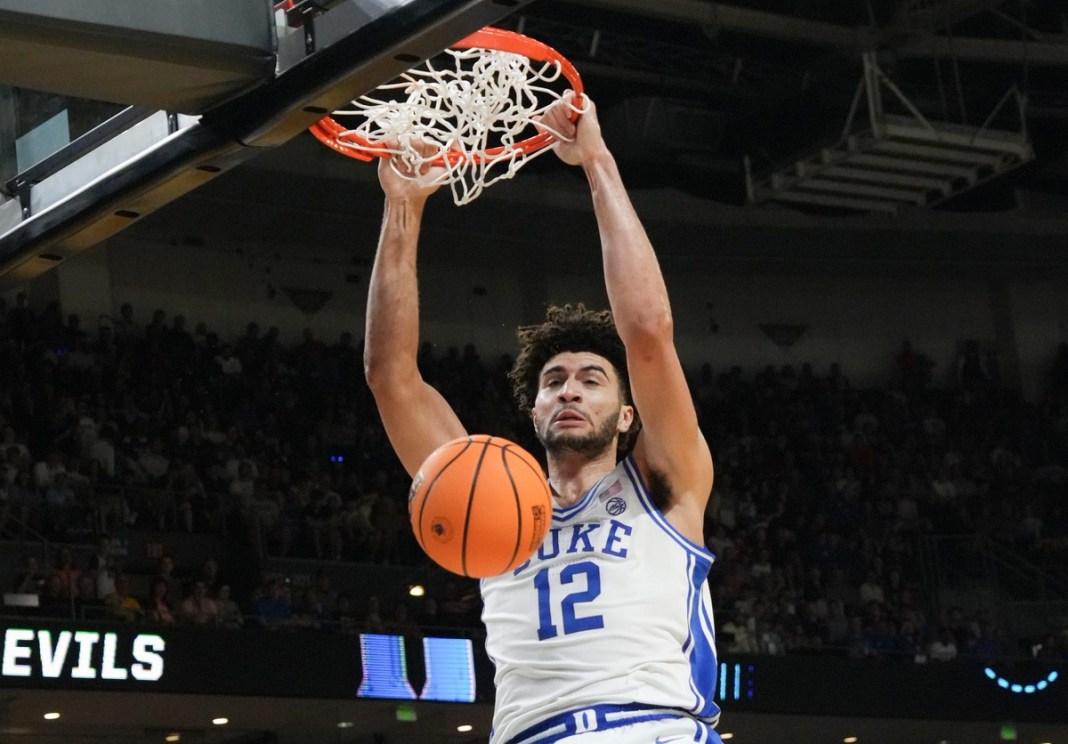
Cameron Boozer, Duke: Boozer seems to have a reputation as a slow-footed big that dominated the college game by overpowering opponents, but that couldn’t be further from the reality. While he lacks pop athletically, he moves well laterally and his mind for the game, along with his outrageous skill set, makes up for all of his deficiencies. Despite being a freshman last year, Boozer finished No. 1 in the nation in Box Plus-Minus (17.1). He’s a high-feel player with touch around the basket, excellent vision, and a reliable three-ball. There’s a good chance he ends up being the best player in this loaded class, and what he brings to the table as a winning player shouldn’t be ignored.
Darryn Peterson, Kansas: Peterson had a strange season at Kansas. That’s really the only way to explain it. After showing out as an on-ball guard in high school, Peterson was more of an off-ball scorer — and really a movement shooter — with the Jayhawks. Peterson filled that role admirably, looking the part of a great two-guard prospect at the next level. However, those that watched his high school tape will tell you that there’s way more on-ball juice than he showed us in his one year under Bill Self. If the guy we saw in high school is still somewhere in there, Peterson has the potential to be an All-NBA guard. His shot-making ability, athleticism, and flair all make him special. However, Peterson also enters the draft with some question marks surrounding his mental make-up, which is never what you want.
AJ Dybantsa, BYU: Dybantsa is the betting favorite to go No. 1 in the draft, as he has a nice combination of a high floor and a high ceiling. At just about 6-foot-9, Dybantsa is built like an NBA player already, he possesses an advanced offensive arsenal, and he’s wired the right way. He genuinely believes he’s the best player in this class, and he’s eager to prove himself as one of the best players on the planet. Dybantsa also posted stupid numbers at BYU, averaging 25.5 points, 6.8 rebounds, and 3.7 assists per game. He should be a high-level contributor immediately, he’ll give his next team positional versatility, and he’s as safe a prospect as there is at the top of a draft. Dybantsa just has to prove himself as a three-point shooter, and he needs to answer questions about defensive consistency.
Darius Acuff Jr., Arkansas: If the Knicks winning a title with Jalen Brunson as their best player helped any of these draft prospects, it’s Acuff. The Arkansas guard is an elite pull-up shooter, an awesome pick-and-roll playmaker, and a great leader. John Calipari, who is no stranger to coaching sensational NBA guards, has done nothing but gush about Acuff, singing his praises as a future pro. Well, perhaps we should listen to him. Acuff feels like the best bet in this class to serve as a legitimate offensive engine at the next level, and the major concern with him is the defense — on and off the ball. Well, if Mike Brown was able to figure it out with Brunson, are we sure a winner can’t be built around Acuff?
Caleb Wilson, North Carolina: Wilson is viewed as the No. 4 player in this class, though some analysts and scouts do prefer him to some of the guys listed above him here. Wilson just has eye-opening athleticism, which he uses to throw down monstrous dunks in the open floor and make winning plays on the defensive end. Wilson just has to continue improving as an actual basketball player. The word is that he wants to be more of a small forward, and he’ll need to improve as both a shooter and ball handler in order to be that. However, he seems best suited as a four, or a small-ball center. If that’s the route his next team ends up going with him, adding size will be the main goal.
Keaton Wagler, Illinois: Wagler entered his freshman season as a relative unknown. He wasn’t a five-star recruit, nobody had real expectations for him in Year 1, and he was mostly considered a catch-and-shoot player. Well, Wagler turned some heads in practice, forcing Brad Underwood’s hand in making him the primary on-ball option for the Fighting Illini. That proved to be a season-changing move, as Wagler averaged 17.9 points, 5.1 rebounds, and 4.2 assists per game, serving as the engine of an elite Illinois offense — and one that ultimately made the Final Four. Wagler now looks like one of the best guards in this draft, as he’s big, can really knock down shots, and has a unique game when it comes to attacking off the dribble. If his lack of speed doesn’t completely weigh him down, he’ll be a great pro.
Aday Mara, Michigan: Mara helped himself more than anyone during the NCAA Tournament. While you never want to judge prospects on a small sample size like that, it was just obvious how impactful he is on both ends of the floor. Mara is a 7-foot-3 big that can put a lid on the rim, while also doing a decent job of stepping out and guarding away from the basket. There’s a good chance he’s a high-level defensive anchor in the NBA, even if it takes him a year or two to get comfortable with the speed of the game — as it did in college, as his true breakout came in Year 3. Offensively, Mara is a good play-finisher, a decent ball-mover, and a strong offensive rebounder. There’s hope he’ll eventually be able to shoot, but that’d just be a cherry on top. What he does now, on both ends, is highly valuable — especially with physical play inside making a comeback in the NBA.
Mikel Brown Jr., Louisville: Brown’s season with Louisville wasn’t quite as weird as Peterson’s was with Kansas, but I’m not sure anyone was happy with the way things went in his lone season in Kentucky. Still, Brown did put some interesting stuff on tape. At 6-foot-5, he’s a dynamic off-the-dribble shooter, a dangerous catch-and-shoot option, and a very good playmaker. Brown was also the only high-major freshman outside of Trae Young to shoot at least 14 threes per 100 possessions while also finishing with an assist rate of 29.0% or higher, according to Bart Torvik’s database. If teams are comfortable with his medicals, and feel they can work with him defensively, there’s major upside here.
Brayden Burries, Arizona: Burries is a little older than the other guards at the top of the draft, but that shouldn’t scare teams off. He’s coming off a season in which he ended up being Arizona’s best player, and that was a Wildcats team that was as good as anyone in the nation. Burries averaged 16.1 points, 4.9 rebounds, 2.4 assists, and 1.5 steals per game, and his 49.1/39.1/80.5 shooting splits were impressive. Offensively, Burries can play a little on the ball, but he profiles best as a three-level scorer at the two-guard position. Defensively, he has solid size and really competes, which is how he was able to earn Tommy Lloyd’s trust as a freshman. It’s pretty easy to see where he fits in the NBA.
Kingston Flemings, Houston: Flemings’ combine measurements caught people off guard. Flemings ended up measuring in at 6-foot-2.5 barefoot, and his wingspan is just 6-foot-3.5. That lack of length is a killer. Flemings was a good defender at the college level, but small guards get picked on relentlessly. Will he be able to avoid being a target in the NBA? Either way, there’s still a lot to like here. Flemings is quick, he’s good at keeping defenders on their toes, and his poise is off the charts. Flemings is also a good three-point shooter, and he’s a natural-born leader. He should be a good pro, even if his ceiling might look a little lower than it did before the combine.
2026 NBA Draft Thoughts: Random Takes & Observations
- I really think the Wizards should be drafting Boozer. I get the arguments for both Dybantsa and Peterson, and you’ll see below that I have both as best bets. However, I strongly believe Boozer is the best player in this class, and his maturity and feel would make for a great fit on a team looking to make a major jump in 2026-27. I don’t think the Wizards will end up regretting anything, and this isn’t an actionable take. But it’s one I want on the record.
- If the Hornets don’t trade their picks for Domantas Sabonis, I’d expect them to end up with one of the following players: Yaxel Lendeborg, Morez Johnson, or Allen Graves. We’ll look for ways to bet this closer to the draft, but Charlotte can use a big body at the four. This draft has a bunch of them. Graves could ultimately be the guy. The Hornets are apparently hot for him, and I wouldn’t be shocked to learn that he has a draft promise from someone in the lottery. He turned down a Will Wade offer to return to college and play for LSU. Knowing what we know about Wade, that bag was probably massive.
- Bennett Stirtz is being severely underrated. I know he doesn’t look like much of an athlete, but he’s a great shooter, a good passer, and a very advanced scorer when looking at twos. The last one is the big one. Analytically, he looks like a special player inside the three-point line, and the eye test backs it up. He has good touch when he gets two feet in the paint, and playing with NBA spacing should fully unleash him. I honestly wonder if there’s some Austin Reaves or Jalen Brunson here, and a lot of people are saying the Pistons could be a landing spot. That’s a fun one. Putting Stirtz next to Cade Cunningham could help Detroit’s offense significantly. Also, playing for the Pistons could mask some of his defensive shortcomings.
- Two other players I like in the 15-25 range: Joshua Jefferson and Ebuka Okorie. Jefferson feels like someone that goes to a winning team and carves out a starting role. He has really improved as a shooter, he’s an awesome passer, and he also makes energy plays. Meanwhile, Okorie isn’t mentioned with some of the other guards near the top of the draft, but he’s absolutely electric with the ball in his hands. Sure, he’s a little smaller than you’d like, but there’s some Keyonte George to him. He can really make things happen off the dribble and he gets to the free throw line. If the jumper is legit, he’ll outperform his draft slot.
- If Jayden Quaintance’s medicals look alright, he could end up being the steal of this draft. If the big man didn’t tear his ACL in his freshman season with Arizona State, there’s a chance we’d be talking about him as a top-five pick in this draft. His ability to protect the rim is borderline violent. He’s also very light on his feet, making him one of the most switchable bigs we’ve seen in a while. Quaintance is also intriguing on offense, as he’s a reliable rim-runner that can also put the ball on the floor. Of course, there is a wide range of outcomes that can come with his draft night. His tools can get him picked earlier than expected, or the weird year he had in Kentucky, and some of the comments he made, can cause him to slide. But this is an impressive talent with game-changing ability.
- Alex Karaban and Zuby Ejiofor, two older prospects in this class, will be good pros. Karaban has size, a reliable three-point shot, defensive versatility, and a winning pedigree. I don’t want to get carried away with overvaluing the Villanova-ness of the Knicks, but he brings some of that with what he did for UConn. As for Ejiofor, I just love the size, toughness, and motor. He was a freaking monster for St. John’s, and he should be good in a small-ball big role at the next level.
2026 NBA Draft Best Bets
In-Pocket Plays (Before Publish)
AJ Dybantsa To Go No. 1 (+135 – 3 units) – I wrote this up for the website back on March 1, and I talked about it on Hardwood Handicappers immediately. At the time, Dybantsa just seemed like he was going to be too tough for the team drafting No. 1 to pass on. He’s now an overwhelming favorite to go to the Wizards.
Brayden Burries To Go Top 10 (-175 – 1.5 units) – Once it started getting out that Rich Paul was trying to force Burries’ way to Dallas, I jumped in with a play in this market. Rather than take him to go to the Mavericks, this protects against Burries going earlier — or one spot later — than expected.
Darryn Peterson To Go No. 1 (+415) – I don’t think Peterson will go No. 1, but I figured I’d try to hedge my Dybantsa play once Shams Charania reported on the uncertainty Washington is dealing with at No. 1. As long as Boozer doesn’t go No. 1, we should do well when the first player comes off the board on draft night.
Recently Added Best Bets
Darius Acuff Jr. To Go No. 4 (20-1 – 0.1 units) – This is a very, very small play for me, but it’s a dart worth throwing. Chicago worked out Acuff, so you’d have to think he’s at least being considered. The talk surrounding the Bulls is that Bryson Graham, the team’s new decision-maker, wants big, lengthy athletes, so a player like Wilson, who is viewed as the No. 4 prospect, does make sense. But Acuff might be the best basketball player outside of Boozer, Peterson, and Dybantsa, and he’d be a dream fit in Chicago. Are we 100% sure the Bulls are going to swing on Wilson? The upside is out of this world, but he’s definitely tool first, skills second. Passing on Acuff and drafting an awkward fit next to Matas Buzelis — and last year’s first-round pick Noa Essengue — could be risky.
Nate Ament Draft Position Under 10.5 (-105 – 1.5 units) – It sounds like the Bucks really like Ament at No. 10, and other teams have registered interest in him before that.
NOTE: I’ll have more once more markets start showing up. Check out Hardwood Handicappers for more draft talk!