



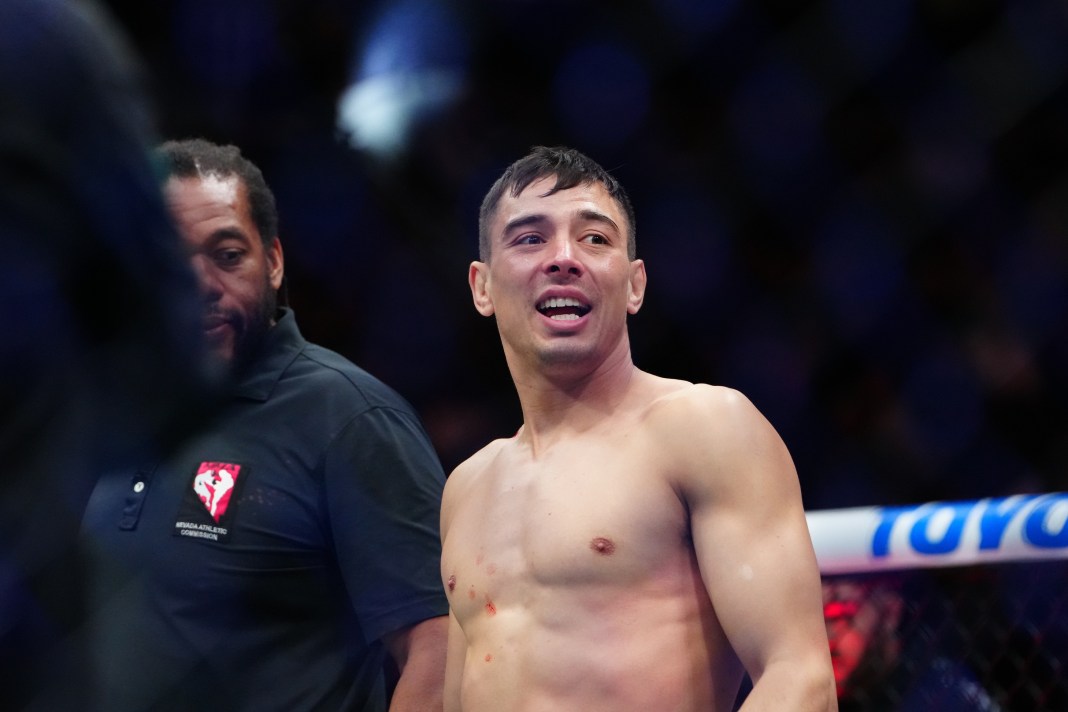
The 2026 record now sits at 74–43–6 — 63.25% on the year. This week the UFC heads to Baku for a lightweight showdown between Rafael Fiziev and Manuel Torres.
Dave Ross and I broke down the full card on this week’s First Strike with Dan Vreeland (@GumbyVreeland). Find the podcast everywhere you listen and on YouTube. Make sure to subscribe and share!
Let’s dig in.
Asu Almabayev vs Charles Johnson
Asu Almabayev has quietly put together one of the stronger UFC runs in the flyweight division over the last two years. Since entering the promotion in 2023 he’s gone 6–1, with his only loss coming against Manel Kape, a man who may very well be the division’s next title challenger. Most recently Almabayev submitted Alex Perez in November and enters Saturday on a two-fight win streak.
Across from him is Charles Johnson, whose UFC career has been a more uneven ride at 8–6 in the promotion. He’s fought twice already in 2026, going 1–1, most recently picking up a decision win over Bruno Silva in March. Something worth flagging on Johnson’s résumé is that he holds a TKO victory over current flyweight champion Joshua Van. That win matters. But the broader record tells the story of a fighter who has struggled to string results together consistently.
Johnson holds the physical advantages with a five-inch reach edge and five inches of height at 5’9 to Almabayev’s 5’4. But the xR% gap is where the picture shifts. Johnson has slipped to 52%, approaching red flag territory and reflecting five UFC decision losses on his record. Almabayev sits at a healthy 69%, a strong mark that reflects consistent round-winning over a growing UFC sample.
The striking profiles confirm their stylistic intentions. Johnson spends 67% of his time at distance, landing 4.77 significant strikes per minute with a +0.75 differential and four UFC knockout victories. He carries genuine power but his 38% head strike accuracy tells you he’s throwing wild and waiting for the right one to land. He’s been dropped three times himself in those exchanges. Almabayev is not interested in that game, spending 48% of his time at distance and landing just 2.31 significant strikes per minute with a +0.32 differential, absorbing only 1.99 per minute. He’s not trying to outbox Johnson. He’s trying to survive the striking and get the fight where he wants it.
And where he wants it is on the ground.
Almabayev holds a 89% control rate in clinch and ground exchanges — an elite mark — compared to just 20% for Johnson. He spends 47% of his fight time in a control position and has scored 27 takedowns at 43% accuracy while averaging 7.29 takedown attempts per five minutes. Johnson defends at 69%, which is workable, but history suggests he struggles badly against high-volume elite grappling pressure. Muhammad Mokaev took him down 12 times. Cody Durden took him down 11 times. A relentless grappler who commits to that path has consistently found success against Johnson, and Almabayev’s profile fits that blueprint perfectly.
The model runs it through and delivers a 71% win probability for Almabayev with full confidence, Tier 1 Favorite. The moneyline has climbed from –220 to –258 through the week, sitting almost exactly on top of the model’s implied probability. The value on the straight bet has essentially evaporated.
Where the edge remains is the method. Almabayev by decision at +100 reflects how this fight most likely plays out. A grinding, grapple-heavy performance where he controls rounds without necessarily finishing. That prop is the target when it becomes available in Vegas. He’s also a strong candidate as a parlay piece given the model’s full confidence in his chances.
Rafael Fiziev vs Manuel Torres
This main event matters for Rafael Fiziev. Despite facing elite competition throughout his UFC run, he still finds himself 1–4 in his last five. Two losses to Justin Gaethje, a TKO loss to Mateusz Gamrot due to a leg injury, and most recently a knockout at the hands of Mauricio Ruffy in January. He’s bounced back from adversity before, and Saturday gives him the chance to do it again in front of a home crowd in Baku.
Across from him is Manuel Torres, one of the more exciting young fighters in the lightweight division. Since making his UFC debut he’s gone 5–1, with his only loss coming against Ignacio Bahamondes, the same man Fiziev beat to get back in the win column. Outside of that loss, Torres has five first-round wins in the UFC and has only gone past the first round once in his entire MMA career. He finishes fights, and he finishes them fast.
Before we go any further, Torres barely qualifies for the model this week. His fights have been so short that the data is thin, and that caveat needs to stay on the table throughout this breakdown. We’re running it because the card is light and the matchup is the main event, but treat the output with appropriate skepticism.
Torres holds a two-inch reach and height advantage. The xR% gap is enormous, though context is critical. Fiziev sits at 47%, in red flag territory, though two difficult decision losses to Gaethje account for a meaningful portion of that decline. Torres checks in at 83%, driven largely by first-round knockouts that produce perfect round-winning metrics. Dominant finishes inflate that number in ways a larger sample might not sustain.
The finishing profiles are both real. Torres has four UFC knockouts and one submission. His power is not in question. Fiziev has three knockout victories of his own, though his last came against Rafael Dos Anjos back in 2022. Torres has suffered one knockout in the UFC. Fiziev has been stopped by TKO three times.
The striking numbers are where the gap becomes most visible. Both men spend 80%+ of their time at distance. This is likely a striking fight first. Fiziev lands 4.71 significant strikes per minute with a –0.13 differential. So he’s absorbing slightly more than he’s landing overall, and has scored only two knockdowns across 12 UFC fights. Torres lands 6.69 significant strikes per minute with a +2.36 differential, absorbing 4.33 per minute. Higher volume, cleaner execution, and four knockdowns already in a fraction of the fights.
The grappling is largely academic. Both men defend takedowns at 90%, neither is looking to wrestle, and the combined takedown attempts between them barely register. There is one footnote worth mentioning. Fiziev used takedowns strategically against Bahamondes, landing four in that fight alone, which accounted for half his UFC career total. Could a similar mixed approach surface on Saturday? It’s worth noting, even if it’s unlikely to define the outcome.
Running it through the model the output lands on the underdog. Manuel Torres receives an 81% win probability and a Live Dog designation. That number feels high given the sample size limitations, and we’d scale it back somewhat when applying real-world judgment. But even discounted, the edge is real.
His current odds sit at +100 — essentially a pick’em — and that price has already drifted to –110 or -105 at some books this week.
Live Dogs have been cold recently in the model, but the category is still profitable on the year, and this is the spot to trust one.
*Check out FightingWithNumbers.com for the full model tale of the tapes, grades, and reports on the fights this weekend.
Good luck Saturday. Enjoy the violence.