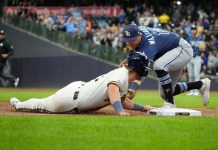




We have one Wild Card rematch in the AL and one in the NL, but the venue has changed in the Senior Circuit, as the San Diego Padres will host the Chicago Cubs. The Cubs won the best-of-three series at Wrigley Field in last year’s postseason, but then fell to the Brewers in the NLDS in five games. The winner of this series draws the Brewers in this year’s postseason, as the Cubs look to advance past the NLDS for the first time since 2017 and the Padres, who are one of five MLB clubs to never win a World Series, will hope to get past the DS for just the second time since 1998.
Of course, before worrying about that, this best-of-three Cubs vs. Padres Wild Card Round must be completed. These are two teams whose playoff tickets have been punched for a while, so they’ve been able to set up everything accordingly. A September surge from San Diego is why this series is at Petco Park, as the Padres have only lost four times since September 2. In fact, if you combine the 18-6 September record with the 17-11 mark from August, you’re talking about a team playing at a very high level heading into October. The Cubs, meanwhile, were just 11-13 in the final month of the regular season.
To say that home-field advantage is a big deal for San Diego may be an understatement. The Friars were 51-30 in the friendly confines during the regular season and held opponents to just 307 runs, an average of 3.8 R/G. Neutralizing the dynamic Cubs offense is the key to this series for San Diego. Nobody scored more runs than the North Siders, who finished with 850 runs, 18 more than the Brewers, who won the division by 14 games.
This should be a really exciting series, as we’ve got the best offense in baseball against arguably the most talented bullpen.
Cubs vs. Padres Wild Card Round Odds
Padres -120 // Cubs +100
Total Games: 2.5 (-110/-110)
Cubs vs. Padres Wild Card Round Schedule
*all games in San Diego
Game 1: Tuesday, September 29, 10 p.m. ET (Peacock/NBCSN)
Game 2: Wednesday, September 30, 10 p.m. ET (Peacock/NBCSN)
Game 3: Thursday, October 1, 10 p.m. ET (Peacock/NBCSN) – if necessary
Cubs vs. Padres Offense
Edge: Cubs
For the uninitiated, there’s a stat called wRC+, or weighted runs created plus. The “plus” means that the stat is park-adjusted and adjusted to the league run environment, so we can compare offenses in the context of that season and by taking into account whether or not their ballpark (and the road ballparks) are favorable for offense or pitching. When you consider the home venues for these two teams, taking park factor into account is very important.
Petco Park is almost always better for pitchers with that marine layer in San Diego. Wrigley Field is dependent on the wind and weather, as it can be a miserable hitting venue in April and May, but a launching pad in the summer months. Taking the entirety of the situation into play, the Cubs finished the regular season with a league-leading 114 wRC+, meaning they performed 14% better than league average when taking those factors into account. The Padres were ninth with a 102 wRC+.
The Cubs were +7 in BA, +20 in OBP, and +30 in SLG, but you do have to consider the ballpark elements. The Padres led the league in stolen bases with 164, so they kept their ballpark shortcomings in mind to find other ways to generate offense. Chicago hit 220 home runs, the third-most in the league, while the Padres hit 183, tied for 14th. Chicago struck out less often and walked more often, but, again, park factor has to come into play there because pitchers feel more comfortable pitching to contact in Petco Park. Even with that sentiment, San Diego was sixth in home BB% at 9.9%. The Cubs, unsurprisingly, were first in the league at 11.4%.
Even if we take the Cubs out of Wrigley, they were second in road wOBA at .329 and posted a 107 wRC+, tied for second with the Astros, trailing only the Dodgers.
If we consider contact quality and expected offensive stats, the Padres finished with a xBA of .246, higher than the Cubs at .244. The teams were nearly identical in xSLG, with the Cubs at .399 and Padres at .398. San Diego had a higher Hard Hit% and higher Barrel%.
While the Cubs do have the offensive edge, it’s not as big as some might make it out to be given the disparity between runs scored and home runs for the two teams.
Cubs vs. Padres Pitching
Edge: Padres
We can’t talk about pitching without talking about defense. The Cubs finished the regular season with a 4.12 ERA that ranked 14th, but they were 24th in xERA at 4.54 and 25th in FIP at 4.60. Why was their ERA so much lower? The Cubs had the second-highest left on-base percentage at 75.7%. Per Outs Above Average, Statcast’s primary defensive metric, Pete Crow-Armstrong was the best fielder in baseball. Dansby Swanson was 10th. Collectively, the Cubs were +74 Outs Above Average, resulting in 60 runs prevented.
Conversely, the Padres were +18 Outs Above Average, which resulted in 14 runs prevented. Defense matters and no team in baseball was better on defense than the Cubs. That’s why the pitching staff overachieved from a run prevention standpoint. The Cubs had the fifth-lowest BABIP (batting average on balls in play) against, despite the seventh-highest Hard Hit% against and third-highest Barrel% against. Only the Athletics allowed more home runs than the Cubs.
Neither one of these teams got good starting pitching. They were 22nd (Cubs) and 27th (Padres) in xERA as a starting staff and 25th (Cubs) and 26th (Padres) in FIP. Both teams had very low strikeout rates from the starters and those guys gave up too many home runs, especially in Chicago’s case.
The bullpen, though, is where the Padres had a decisive advantage, sitting fifth in ERA, first in xERA, and second in FIP. Across those three categories, the Cubs were 13th, 25th, and 26th. San Diego was fourth in K% as a relief corps. Chicago was 24th. In the specialized playoff environment, where managers leverage relievers differently and don’t stretch starters out to turn the lineup over a third time, dominant bullpens can be game-changers. The Padres have a dominant bullpen.
I will say that the low guys on the totem pole out of the pen don’t really pitch in the postseason and often don’t make the roster, so, in theory, everyone’s bullpen numbers have the chance to improve. That said, the Cubs had very few dominant relievers. That’s not the case for the Padres.
Cubs vs. Padres Miscellaneous Notes
I do think that the Cubs have a managerial advantage here. It took a while for Craig Stammen to find his sea legs for the Padres and Craig Counsell has been through this before. He’s 4-4 with the Cubs after going 7-12 with the Brewers in the postseason. There were a lot of skeptics about Stammen early, especially with San Diego sitting 48-48 with a -43 run differential at the All-Star Break.
Both of these teams like to run, the Padres more than the Cubs. San Diego led the league in caught stealings with 51 with a 32.5% CS%. The Cubs were at 25.8%. The league average was 23%, so both teams were above average at cutting down the running game. Because of the postseason environment, baserunners are harder to get and getting runners thrown out is often more costly than usual, so we’ll see how aggressive the two teams are. I should also note that Ethan Salas did not throw out any of the six would-be base stealers at the MLB level during the regular season.
Cubs vs. Padres Wild Card Prediction
Pick: Padres -120
The deciding factor between these two teams is very clear to me. San Diego has the better bullpen. It is a very deep group and features two of the league’s top relief arms in Mason Miller and Adrian Morejon. Most teams that are analytically driven are built to win at home and play .500 or slightly better on the road. Power production costs money. Other things cost money. The fact that the Padres were so good at home suggests to me that their roster construction worked.
This series does carry a fairly high degree of variance because the expected starting pitchers (Michael King, Nick Pivetta, Robbie Ray for SD; Matthew Boyd, Kevin Gausman, Clay Holmes for CHC) feature a lot of pitch-to-contact guys, so offensive sequencing will go a long way. But, like I said, I think San Diego’s bullpen is the separator here.
Other series previews: Phillies vs. Braves | White Sox vs. Astros | Red Sox vs. Yankees